
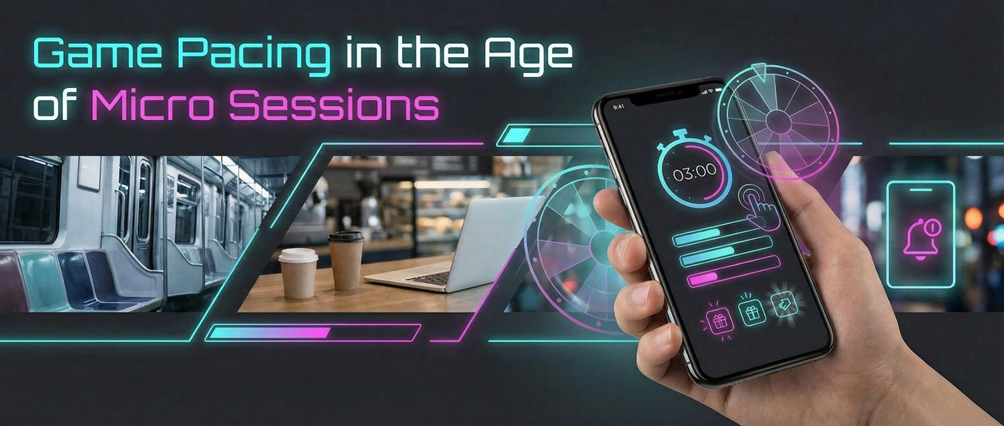
Something’s shifted. Subtly at first, then clearly. The way people play games – when, where, and for how long – is changing. Long sessions, once the default, are being nudged aside by shorter, sharper bursts of gameplay. Five minutes here, ten minutes there. It’s not a temporary trend; it’s a structural shift.
And at the centre of it all? Mobile-first design. That, and a generation of players whose habits don’t match the old formats anymore.
Let’s take a closer look.
Mobile-First Design Has Changed the Blueprint
The mobile phone wasn’t originally built for gaming. That much is obvious. But over time, its design limitations have forced developers to think differently – tighter loops, fewer inputs, cleaner UX. No keyboard, no controller, no giant screen. Just your thumbs, a touchscreen, and a few spare minutes.
So what do you do with that? You don’t build hour-long raids or 45-minute story arcs. You build for bursts. For moments. For someone sitting on a train or waiting for coffee.
In practice, this has led to a new standard: quick access, minimal loading, and gameplay that’s understandable in seconds. Look at games like Clash Royale, Subway Surfers, or most browser-based casino online experiences – they all deliver something meaningful in under a minute. No fluff, no warm-up.
And we haven’t even touched on daily missions, push notifications, or timed events – design tools created to fit around people’s lives, not disrupt them.
It’s UX built for speed, not scale.
Micro Doesn’t Mean Shallow
Let’s clear something up. Just because sessions are shorter doesn’t mean games are less rich.
Actually, shorter games are often harder to design. You have to be tighter with your feedback, faster with your reward cycles, and more intentional about what you show first. There’s no time to “build up” – you need to hit the player immediately, then layer depth quietly in the background.
The most clever examples manage to do this almost invisibly. A basic mechanic upfront (drag, tap, spin), followed by options that gradually emerge – power-ups, upgrades, multipliers, meta systems. This holds whether you’re building a mobile idle game, a three-reel slot, or a gamified loyalty loop in a casino online app.
It’s light on the surface, dense underneath. Like a good espresso.
Player Habits Are Different Now – And They’re Not Going Back
Let’s be honest: it’s not just about phones. It’s about people.
Players today are multitasking more. Watching something on TV while tapping through a level. Picking up a game during a break, then dropping it mid-session to reply to a message. Not out of boredom – just reality. Life is fragmented, and so is time.
In this new context, games that demand uninterrupted blocks of attention start to feel heavy. A bit too much. Especially when there are alternatives that respect your time and still feel rewarding.
That’s part of the reason casual games and online casino platforms are thriving. You can dip in, get the thrill, and leave – no penalty, no FOMO. Just like that.
The average daily time spent on mobile gaming globally is around 24 minutes – spread across several sessions. Not one big playthrough. Several micro ones.
So yes, the data confirms what we’ve been observing all along.
Session Design Is the New Skill
Designing a great level is still important. So is world-building, narrative flow, combat balance… but let’s be clear: if your game doesn’t pace itself well – session by session – you’re going to lose players early.
The best games now think in cycles:
- Two-minute engagement
- Five-minute reward
- Ten-minute retention pattern
That’s how energy meters, battle passes, and even spin bonuses in casino online setups work. They’re all timed to keep you active without requiring too much at once.
And it’s not manipulation. It’s rhythm. If anything, it’s respectful – because it recognises how people actually use their time.
This was explored brilliantly in the piece Casual vs Competitive Gaming: Why Short Play Sessions Are Growing. That article breaks down why even competitive genres (like MOBAs or FPS titles) are adapting with shorter, more intense matches and queue-when-ready systems.
What we’re seeing is a convergence. Casual and competitive aren’t opposite poles anymore. They’re both learning to be more flexible.
Closing Thoughts: Less Can Be a Lot More
In the old model, time spent was the measure of success. “This game gives you 100 hours of gameplay.” Now, that’s no longer a selling point for everyone.
Many players don’t want 100 hours. They want five minutes – but five good ones. Something that fits into life, rather than asking to be scheduled.
And games that understand that, and adapt to it, are the ones that are thriving right now. Whether it’s a mobile puzzler, an arcade hit, or a casino online title that lets you play one round and move on, the winners are the ones that don’t overstay their welcome.
The rules have changed. And to be honest, they make a lot of sense.