

Are you also confused about the ranking system in Valorant? Whether a new gamer who has just dived into the world of tactical shooting with Riot’s exclusive game. Or you are a seasoned player who is stuck in Silver and hoping to get that golden Radiant badge, knowing the Valorant ranks in order is the first step to leveling up your grind.
In this guide, we’ll break down every rank, how the ranking system works, and the rank distribution. Keep reading till the end to find out exclusive gamer tips that will help you rank up faster.
All Valorant Ranks in Order
Okay, first things first. There are 25 ranks in Valorant distributed across 9 tiers. Except for the Radiant tier(Golden Badge), all other tiers have three divisions to give the players a feeling of steady progress when they move forward.
- Iron 1, Iron 2, Iron 3
- Bronze 1, Bronze 2, Bronze 3
- Silver 1, Silver 2, Silver 3
- Gold 1, Gold 2, Gold 3
- Platinum 1, Platinum 2, Platinum 3
- Diamond 1, Diamond 2, Diamond 3
- Ascendant 1, Ascendant 2, Ascendant 3
- Immortal 1, Immortal 2, Immortal 3
- Radiant (the single highest rank in the game)
Fun to know fact here is that when Valorant first launched, it only had 22 ranks. Ascendant was added later to fix the distribution curve and give a smoother experience while moving through the ranks. This introduction was done in Episode 5, Act 1.
As you climb through the Valorant ranks, it’s also exciting to keep track of updates, like the Valorant Waylay release date and when you can play the new agent, which can add fresh strategies to your gameplay.
Valorant Rank Distribution
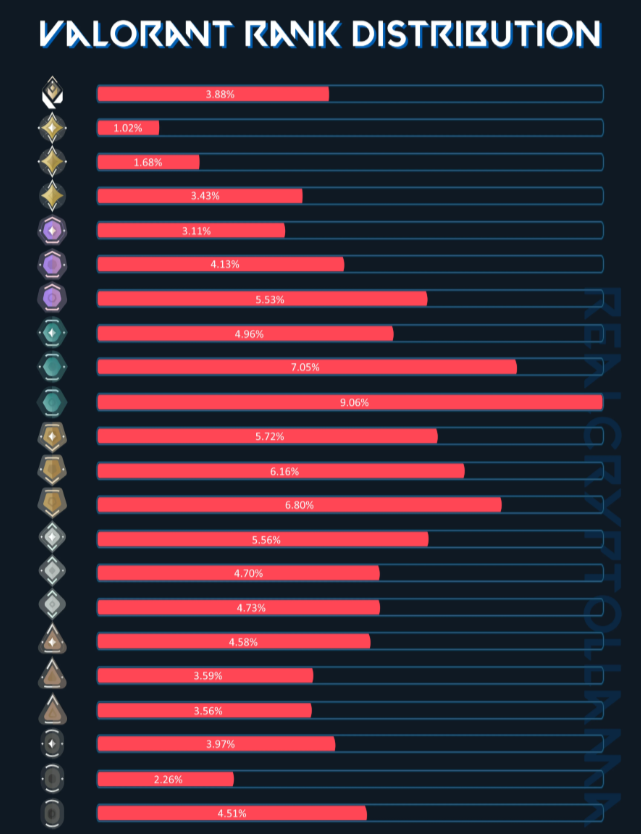
How many players are actually managing to hit Radiant? Or even Ascendant? Well, Riot’s recent data shows that most of the player base is stuck in the middle, with only a tiny percentage staying in the peaks of Immortal and Radiant. Here is the rank distribution according to reports from mid-2024.
- Iron – 9.1%
- Bronze – 24.1%
- Silver – 26.6%
- Gold – 18.6%
- Platinum – 11.5%
- Diamond – 7.4%
- Ascendant – 2.1%
- Immortal – 0.2%
- Radiant – 0.009%
It is easy to analyse from here that most of the players are stuck in Bronze and Silver, and less than 1% have made it to Immortal, let alone Radiant. In fact, the Radiant position is reserved for a select few, the top 500 players in a region. So if you are aiming to hit Radiant, you better get ready for a serious grind.
How to Unlock Ranked in Valorant
If you’re brand new to Valorant games, you can’t jump straight into Competitive. To unlock ranked:
- Reach account level 20 by playing Unrated, Swiftplay, or Spike Rush.
Before Episode 4, the requirement was just 10 unrated wins, which made smurfing too easy. Riot’s new system ensures players actually learn the basics before diving into sweaty ranked matches.
How Valorant Ranks Work

Once ranked mode is unlocked, you’ll need to complete five placement matches to get your initial rank. Here’s how the system works behind the scenes:
- Riot uses a hidden MMR (Matchmaking Rating) to determine your skill level.
- Your visible rank (Silver, Gold, Diamond, etc.) is a reflection of that MMR but not always perfectly aligned.
- Performance in matches—win/loss, round margin, and individual impact—affects how much Rank Rating (RR) you gain or lose.
You’ll typically earn:
- 10–50 RR for a win
- 0–30 RR lost for a loss
- 0–20 RR for a draw
You need 100 RR to climb to the next division. After promotion, you start at 10 RR, while demotion sets you at 70 RR. This ensures smoother transitions and prevents instant drop-backs.
While climbing the Valorant ranks, players often look for extra ways to enhance their experience, such as using a Valorant redeem code to unlock exclusive items and boosts.
Tracking Rank Progression
Want to know how close you are to ranking up? Valorant makes it easy:
- Head to the Career tab in the main menu.
- Check your Match History for RR gains and losses.
- Use the progress bar to track how far you are from the next promotion.
And if you’re chasing the leaderboard, Immortal and Radiant players can see exactly where they stand among the best in their region.
Valorant Acts and Episodes Explained
The ranked system is tied to Valorant’s seasonal structure:
- Acts = Mini-seasons that last about two months.
- Episodes = Larger chapters made up of three Acts (around six months total).
At the start of each Act, your rank soft-resets. You’ll need one placement game in Acts 2 and 3, but five in Act 1 of a new Episode. Expect to place slightly below your previous rank and grind back up.
What Are Valorant Act Ranks?

Your main rank shows your current skill level, but your Act Rank Badge is like a trophy cabinet that records your highest achievements in each Act.
- Each match you win fills your badge with a colored triangle representing that rank.
- As you climb, higher-rank triangles replace lower ones.
- The badge border upgrades based on how many wins you achieve.
At the end of an Act, your badge is locked in and displayed on your Career page. For Radiant players, it’s often a glorious solid gold triangle.
For players who enjoy tracking progression across games, exploring league champs by release date can give insight into how competitive hierarchies evolve over time.
Valorant Premade Rules
Valorant lets you queue up with your friends in parties up to five players. But the rules change depending on your group:
- Five-stack below Ascendant 3: Normal queue but slower matchmaking, with a 25% RR reduction.
- Five-stack with Immortal players: Much longer queues, still a 25% RR reduction.
- Five-stack with Radiant players: Longest queues and up to a 90% RR reduction.
To prevent unfair lobbies and toxicity, Riot removed four-stacks. Players in Immortal+ can only queue solo, duo, or five-stack.
How to Rank Up Fast in Valorant
Climbing the Valorant ranks isn’t just about raw aim—it’s about mindset, fundamentals, and strategy. Here are some tips to boost your climb:
- Stop obsessing over rank
Ranked anxiety is real. Instead of playing “to gain RR,” play to improve your skills. When you focus on progress, your rank naturally follows. - Warm up every session
Spend 10–15 minutes in the range or on aim trainers like Kovaak’s before hopping into matches. Crisp aim = better results. - Keep your Agent pool small
Learn two or three Agents across different roles. Mastering a few is better than being mediocre at many. - Play with purpose
Don’t autopilot. Track your economy, call rotations, and analyze why you died. Each match should teach you something new. - Chase flow state
Valorant is best played when you’re fully locked in. Remove distractions, focus on comms, and aim for that sweet spot where the game feels effortless.
Final Thoughts
The ranked ladder in Valorant is designed to push players to constantly improve, from Iron all the way to Radiant. With a mix of mechanical skill, strategic play, and mental discipline, climbing the ranks can be one of the most rewarding experiences in all of gaming.
Whether you’re grinding Gold to hit Platinum, or pushing through Ascendant on your way to Immortal, remember: Valorant ranks in order aren’t just numbers, they’re milestones of your growth as a player.
So grab your best crosshair, warm up those flicks, and queue up. Who knows? Maybe Radiant is closer than you think.