
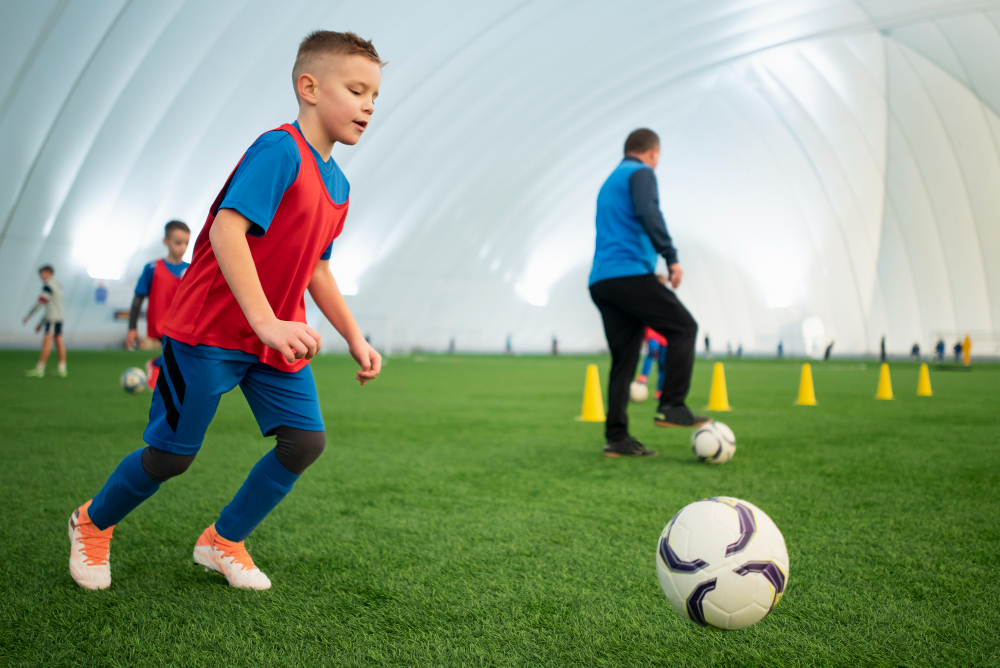
Considered to be a universal attraction, soccer is played by millions for fun. This provides kids with a great opportunity to work on their cardiovascular movements. It can also teach one about teamwork or build self-confidence. Playing time can vary based on age groups. The amount of time allocated for a soccer game depends either on the age group of the players, the grade of competition, or the governing rules.
That is exactly what parents want to know- how much time their child actually spends on the field while moving from seven or nine-a-side to the full 11-a-side? This is when soccer begins to appear and perhaps feel so professionally oriented to 13-year-olds with much longer playing times and greatly increased competitiveness. Hence, the article offers some insights into the kind of 13-year-old soccer-game duration, with its formats relative to other groups, and what to expect for players and their parents during this absolutely important youth transition stage.
Why Soccer Game Length Differs by Age
The length of soccer matches is designed to be mindful of player development and safety. Younger athletes typically are not able to run the full match length like a professional. Instead, the match lengths are shorter both to develop their physical endurance and not put their focus on longer-term conditioning, but instead on skill development. As players get older, the halves get longer and the number of players on the team increases and the dimensions of the pitches get larger. These natural developmental adaptations begin to prepare them for the full adult game into their late teenage years. By age 13, players begin to shift back towards preparing fully for the game and match length is a large factor in their game development.
How Long Is A Soccer Game For 13 Year Olds
Soccer games at the U13 and U14 levels consist of two halves of 35 minutes plus a 10-minute halftime for a total playing time of 70 minutes, not including stoppage and overtime in a competitive match. U13/U14 soccer is also the official start of the 11-a-side style, which is representative of the adult game’s format.
Moving to 11-a-side soccer is a major step for the players. With more players on the field and longer halves, young players are starting to find out what they learned in terms of advanced tactical play, positional responsibility, as well as playing for endurance. The total time is intentionally shorter than the 90 minutes used at older ages to lessen the strain on developing bodies. By reducing the length of the game 20 minutes, coaches and leagues can lessen the likelihood of fatigue and injury with kids, but still encourage the players to develop their endurance and toughness during games.
70 minutes of game time is a good range for a 13-year-old once again, because of the nature of competing and developing. Players start to feel the simulation of match conditions that one could simulate to a degree with adult players, but there are still time limits that lessen the potential of overexertion during.
Comparison With Other Age Groups
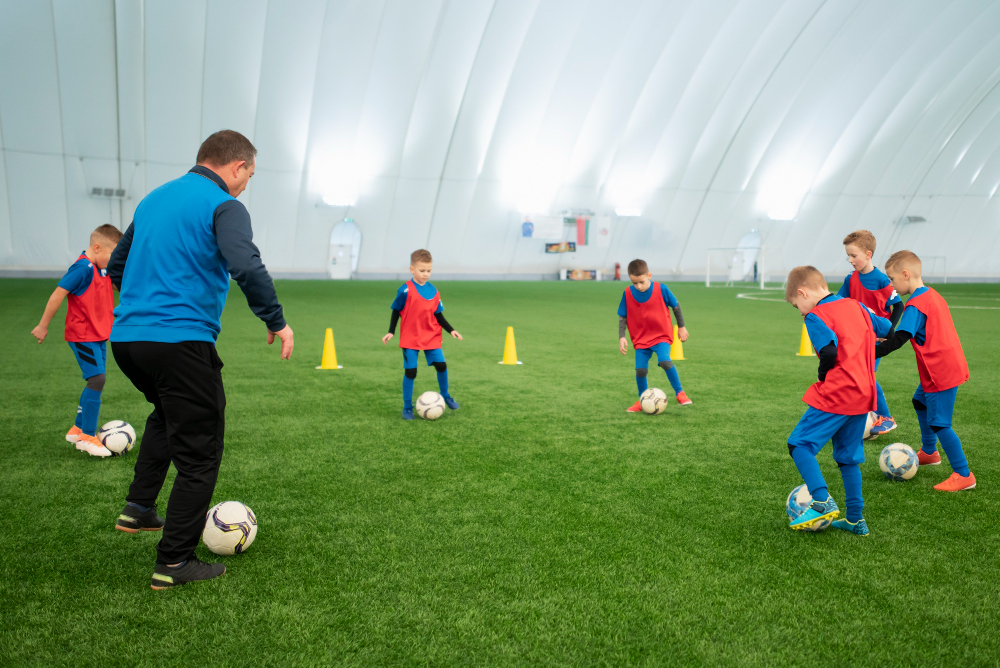
Mini Soccer: (U7–U10)
During these ages, players participate in short matches of two halves (20 minutes each). The smaller teams and format vary in size from five-a-side at U7 to seven-a-side at U9 and U10. Game time is restricted, in order to prevent excessive game time to prevent burnout, and is limited to a maximum of 40 minutes to 60 minutes per day depending on the age category.
U11–U12 Soccer
As soon as players move close to secondary school the format changes to nine-a-side format for the matches, which consists of two halves (30 minutes each). This is also the age players change to a size four ball versus the size three ball used in mini soccer. The increase of time and team size begins to develop a basis for more tactical play.
U13-U14 Soccer
This is the first full 11-a-side game taking place in two halves of 35 minutes. The overall time for the game, 70 minutes, is an ideal time for introducing players to the full playing format while also acknowledging their development.
U15-U16 Soccer
At the u15-u16 age groups, the half times increase to 40 minutes and a total time of 80 minutes for the game. The extra 10 minutes are critical in transitioning players to a full 90 minutes of play at the older age groups.
U17-U18 Soccer
Once we reach 17 years old and older, players play as adults – two halves of 45 minutes, for a total of 90 minutes of play. At this stage of their development, they are able to meet the physical demands of full length soccer as well as the mental demands.
While understanding the standard game duration for 13-year-olds, many young players also dream of one day competing in the top 10 leagues in the world, where match intensity and pace can be a whole new experience.
Halftime and Breaks in Youth Soccer
For 13-year-olds, halftime breaks will typically be about 10 minutes long to allow players time to rest and hydrate, as well as strategize. Halftime for younger groups, such as U10-U12 players, may be shorter than a halftime period that would occur when more mature age players, such as high school or professional soccer, get 15-minutes of halftime. A 10-minute halftime at U13 is a suitable length for the tempo of the game while maintaining a good amount of rest for the developing player.
Overtime and Stoppage Time
For competitive, U13-U14, matches, if the match is tied, there will be 2 (ten) 10-minute overtime halves. Overtime periods are normal in tournament or knock-out matches, both US Club Soccer and US Youth Soccer. Referees also add stoppage time to the end of the half to compensate for time lost from substitutes, injuries, or disruptive play. This purpose is to teach young players how to play under pressure at the end of a game. This will be beneficial to them when they reach higher levels of competition.
Image Credit: source
FAQs
Q1: How long is the duration of a soccer game for 13-year-old players?
Two halves of 35 minutes of soccer for 13-year-olds are followed by a 10-minute halftime, so there are 70 minutes of regulation time.
Q2: Do 13-year-old soccer players have full eleven-a-side games?
Yes, once players hit the U13 stage, they go into full eleven-a-side soccer that in every aspect of field size and rules is an adult game.
Q3: Do U13 soccer matches have overtime?
In the case that the competitors tie, this overtime will be held only in competitive matches and shall include two 10-minute periods.
Q4: Which size soccer ball do 13-year-olds play with?
Here they will be starting with size 5 balls, the same as used in professional and adult soccer.
Q5: How do they train players for the U13 future?
The U13 emphasis is on endurance, tactical awareness in the game, and discipline to train for long matches so that the players can set the foundation for high school and competitive play.
Also Read: Best XP Maps In Fortnite October 2025
Conclusion
At 13 years old, the soccer game really begins to appear like an adult-type assignment. Two halves of 35 minutes each make the duration of seventy minutes for these youngsters to get endurance, tactical awareness, and team spirit going. This stage is very important as the thrill of the full 11-a-side is played with some age-wise adjustments to shield the players against too much pace. Introduced in the game now are Size 5 balls, longer 35-minute halves, and overtime possibilities to create a physical as well as mental challenge for the kids.
Parents can encourage their children to maintain general fitness, good nutrition, and proper recovery programs. As the players get comfortable to this stage, the physical location of their skills together with their mental toughness spends towards these longer 90-minute matches they will play later on with their older teenage years. But in the end, really, U13 soccer is about so much more than game duration; it is about properly equipping the future generation with the proper assistance to survive and thrive in the beautiful game.