
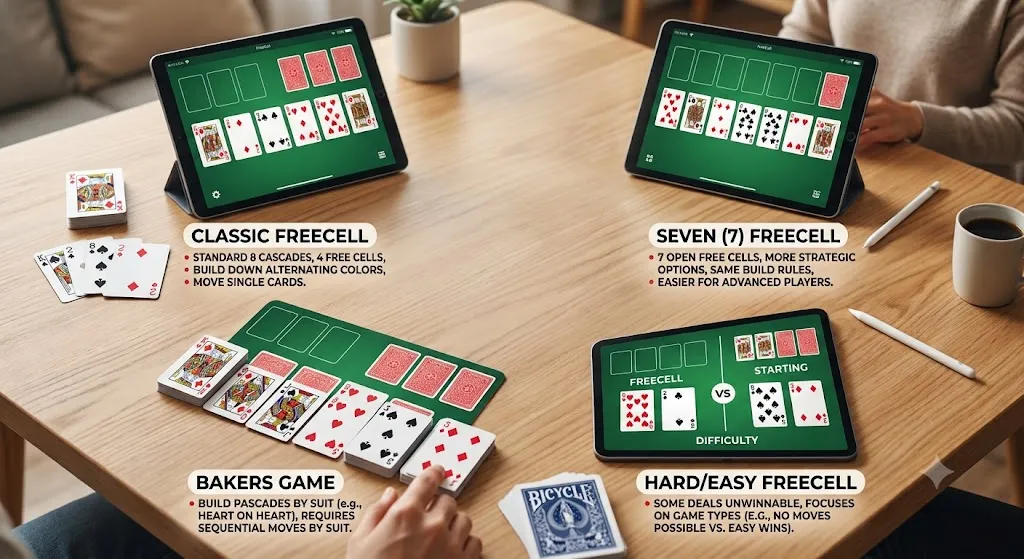
FreeCell variations offer the ultimate upgrade for players looking to sharpen their strategy and test their solitaire skills beyond the classic layout. While millions enjoy standard FreeCell for its 99.9% winnable deals and perfect-information setup, exploring its distinct offshoots opens up entirely new strategic challenges.
By altering tableau rules, sequence building, and storage capacity, these game modes transform how you analyze card structures and execute multi-step plans. Play Freecell online for free on many websites.
What Are the Most Popular FreeCell Variations?

The FreeCell family includes several distinct games that modify the classic balance of free cells and tableau rules. Understanding these popular options helps you choose the right challenge for your skill level.
| Variation | Tableau Stacking Rule | Free Cells | Solvability Rate | Core Difficulty Factor |
|---|---|---|---|---|
| Standard FreeCell | Descending, alternating colors | 4 | ~99.9% | Balanced spatial management |
| Bakers Game | Descending, same suit | 4 | ~75% | Strict suit restrictions |
| Eight Off | Descending, same suit | 8 | ~95%+ | High cell count, King-only spaces |
| Seahaven Towers | Descending, same suit | 4 | ~85–90% | Narrow columns, King-only spaces |
| Penguin | Descending, same suit | 7 | ~90%+ | Variable foundation base card |
How Does Baker’s Game Differ From Standard FreeCell?
Created by mathematician C. L. Baker, Bakers Game is the direct historical predecessor to modern FreeCell. The initial layout deals 52 cards completely face-up into eight tableau columns, guarded by four open free cells above.
The single major rule change occurs in how you build sequences on the board:
- Standard FreeCell: You stack cards downward in alternating colors (for example, placing a red 7 on a black 8).
- Baker’s Game: You must stack cards downward in the exact same suit (for example, placing a 7 of Hearts strictly on an 8 of Hearts).
This strict requirement narrows your sequence options considerably. Because matching suit transfers are harder to set up, free cells clog rapidly. A single miscalculation can lock your board, dropping the solvability rate from nearly 100% down to roughly 75%. Playing Baker’s Game forces you to calculate move chains much deeper in advance.
What Is Eight Off Solitaire and How Do You Win It?
Eight Off Solitaire is a generous yet highly tactical variation that addresses strict stacking rules by expanding your storage capacity. The game deals 48 cards into eight tableau columns of six cards each, placing the remaining four cards directly into the open storage area.
Key rules that define Eight Off include:
- Eight Storage Reserve Cells: You start with eight free cells, giving you massive maneuverability right from the deal.
- Same-Suit Stacking: Like Baker’s Game, cards on the tableau can only be built downward in the exact same suit.
- King-Only Empty Spaces: When a tableau column is cleared, only a King can be moved into the empty space.
To win Eight Off, you must use your eight reserve cells dynamically. Rather than treating reserve Cells as permanent holding bins, treat them as temporary transit points. Your primary goal is to build long suit sequences and clear an entire column early so you can place a King and construct organized foundation ramps.
How Do You Play Seahaven Towers?
Seahaven Towers offers a compact, highly visual puzzle that rewards precision and long-range planning. The game uses a unique layout where 50 cards are dealt face-up into 10 tableau columns containing five cards each. The remaining two cards are placed directly into two of the four available free cells at the start.
The core mechanics of Seahaven Towers feature:
- 10 Narrow Columns: Smaller column depths make it easier to see buried cards, but narrower space limits movement options.
- Same-Suit Sequence Building: Tableau stacks must follow strict downward suit matching.
- Restricted Space Allocation: Empty columns can strictly receive Kings, making empty space creation a precious milestone.
Winning at Seahaven Towers requires immediate board analysis during the opening move. Because two free cells start occupied, your initial moves must focus on liberating those Cells or clearing a column to place a King. It offers an ideal middle ground for players who want strict suit-building without the unforgiving deadlocks of Baker’s Game.
What Makes Penguin Solitaire Unique?
Penguin Solitaire is a modern open-card variation designed by David Parlett that introduces a clever twist on foundation building. Instead of always starting your foundations with Aces, Penguin chooses a randomized base rank.
Here is how Penguin alters the classic formula:
- Dynamic Flipper Card: The first card dealt to the tableau sets the “flipper” rank. The three other cards of that exact same rank are immediately moved to start the foundation piles.
- Seven Flippers (Reserve Cells): You are granted seven reserve cells to manage your board state.
- Same-Suit Downward Building: Tableau sequences build down in the same suit, wrapping around from Ace to King if necessary.
The central challenge in Penguin is locating and liberating the cards that match the flipper rank. Because seven reserve cells are available, the game offers a high win rate while requiring a completely fresh spatial mindset for every deal.
Which FreeCell Game Is Best for Beginners?
For new players transitioning away from standard rules, the ideal progression depends on which skills you want to build:
- For Pure Strategy: Start with Seahaven Towers. The 10 short columns give you a clear visual field while introducing you to strict suit-building.
- For High Win Rates: Try Eight Off. The extra reserve cells give you plenty of room to recover from strategic missteps.
- For Expert Challenge: Play Baker’s Game. It is the ultimate test of forward calculation, punishing impulsive moves and rewarding deep foresight.
How Do Variations Improve Your Classic FreeCell Strategy?
Beyond simple entertainment, playing freecell games for the brain acts as a powerful form of cognitive exercise. Practicing these challenging offshoots directly upgrades your performance in classic FreeCell.
1. Cell Conservation
Suit-strict variations like Baker’s Game teach you never to fill a free cell without an explicit exit strategy. You learn to view free cells as temporary pass-throughs rather than storage lockers.
2. Empty Column Priority
Games with King-only restrictions highlight the massive value of open space. You quickly realize that an empty tableau column is far more powerful than multiple open free cells for shifting long card sequences.
3. Advanced Move Calculation
Navigating tight rules trains your brain to look 5 to 10 moves ahead. When you return to standard FreeCell, alternating-color rules will feel spacious, allowing you to spot winning move chains effortlessly.
Whether you want the tight calculation of Baker’s Game, the expansive layout of Eight Off, or the unique foundation mechanics of Penguin, exploring these game modes ensures your card-sorting skills stay sharp and engaged.