
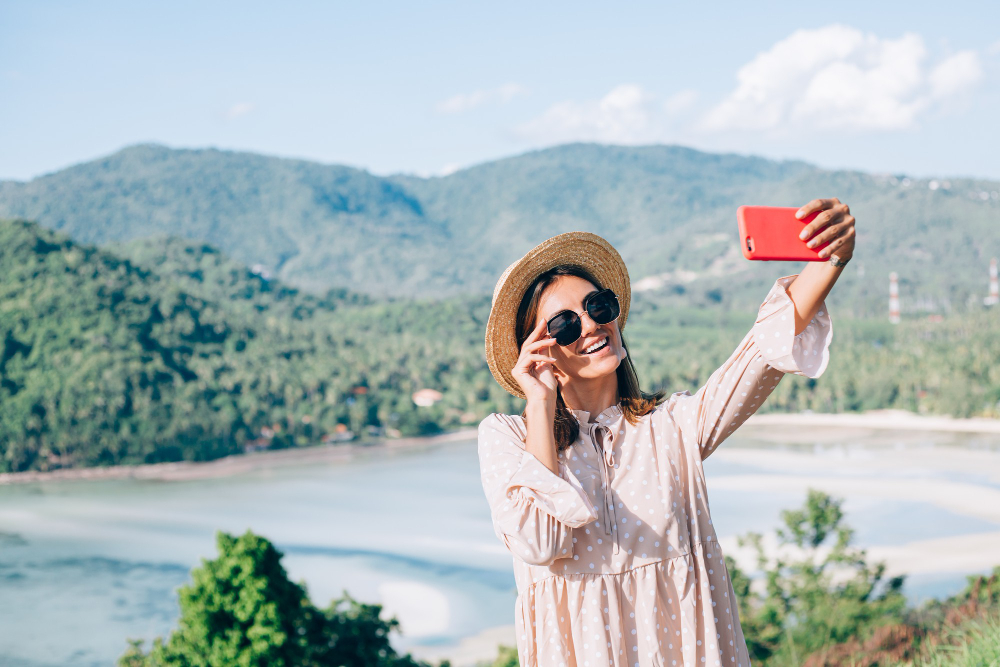
The Uncomfortable Truth About Travel Photo Content in 2026
Here is something most travel content guides will not tell you directly: posting beautiful travel photography to social media is increasingly a losing strategy. Not because the photography is not good — it often is — but because the platforms have fundamentally restructured their distribution logic around video. A stunning landscape photograph now competes for algorithm attention against short-form video content, and the algorithm is not neutral. It consistently favors motion.
The conventional advice — “just start filming more video” — misses the real opportunity. Travel creators are already producing high-quality visual assets in the form of photography. The most efficient path to a strong video content presence is not to abandon that investment and start over with a camera. It is to convert what already exists into the format the algorithm rewards.
The Three Mistakes Travel Creators Keep Making
Before outlining the best approach, it is worth naming the patterns that keep travel bloggers stuck in low-reach, high-effort content cycles.
The first mistake is treating video production as a separate, additive workflow. Creators who approach video as something they do in addition to photography end up doubling their production workload without necessarily doubling their output quality. The result is burnout and inconsistency — the two things that most reliably suppress algorithmic distribution.
The second mistake is underestimating the post-production gap. Many creators invest in AI generation tools, produce genuinely impressive animated clips, and then fail to optimize them for the specific technical requirements of each publishing platform. A beautiful clip in the wrong format, without captions, at the wrong resolution, performs far below its potential regardless of its visual quality.
The third mistake is treating every platform as interchangeable. Travel content that performs well on YouTube requires a fundamentally different structure, length, and format than content that performs well on TikTok or Pinterest. Publishing the same content uniformly across platforms is a reliable way to underperform on all of them.
The Best Method: The Visual Workflow Closed Loop
The approach that consistently produces the strongest results for travel creators combines two complementary tools in a deliberate, sequential workflow. The first handles creative generation — converting static travel photography into dynamic, atmospheric video content. The second handles post-production optimization — ensuring that generated content meets the technical and format requirements of every platform where it will be published.
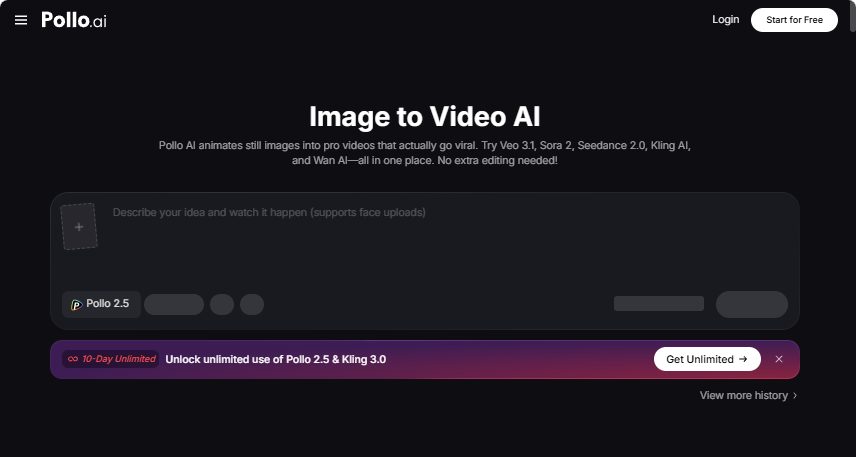
Pollo AI functions as the image to video generation engine in this workflow. It is a one-stop image to video platform that aggregates multiple top-tier AI models to convert static images into high-definition dynamic video. The platform automatically matches cinematic-quality music and surround sound effects to generated clips, producing smooth, detail-preserving video that requires no additional editing. For travel creators, influencers, merchants, and animation professionals, this means existing photography becomes the raw material for compelling video content — without filming a single additional frame.
The second tool handles everything that happens after generation: resolution enhancement, format conversion, background editing, audio work, and captioning. Together, these two tools form a closed creative workflow that takes a travel photograph from static asset to optimized, platform-ready video content.
Step-by-Step Implementation Guide
Step 1 — Curate Your Travel Photo Library With Video in Mind
Review your existing travel photography and identify images that have strong video potential. The best candidates share certain characteristics: clear compositional depth with distinct foreground, mid-ground, and background layers; atmospheric elements that suggest natural motion — water, clouds, foliage, crowds; strong emotional or narrative quality that a viewer can read immediately; and technical quality sufficient to support high-definition video output.
Create a curated selection of your strongest candidates before beginning any generation work. Working from a pre-selected pool of strong images is significantly more efficient than uploading images ad hoc and hoping for strong results.
Step 2 — Generate Animated Clips Using AI Image-to-Video Tools
Upload your curated images to Pollo AI and begin the generation process. The platform’s image to video capability supports multiple AI models — select the model that best suits the visual character of each image. Landscape photography with wide atmospheric depth benefits from models optimized for natural environmental motion. Urban and street photography with human subjects benefits from models that handle complex scene motion more gracefully.
Write specific, contextually appropriate motion prompts for each image. The quality of your motion prompt is the primary determinant of output quality. Generic prompts produce generic results; specific, scene-appropriate descriptions produce output that feels genuinely documentary and immersive.
Generate multiple variations of your most important clips and select the strongest output from each batch. This iteration step adds minutes to the process and consistently produces significantly better final results.
Step 3 — Optimize With Post-Production Tools
This is the step that separates creators who get strong platform performance from those who do not. Raw AI-generated clips, however visually impressive, need post-production attention before they are ready to publish at professional standard.
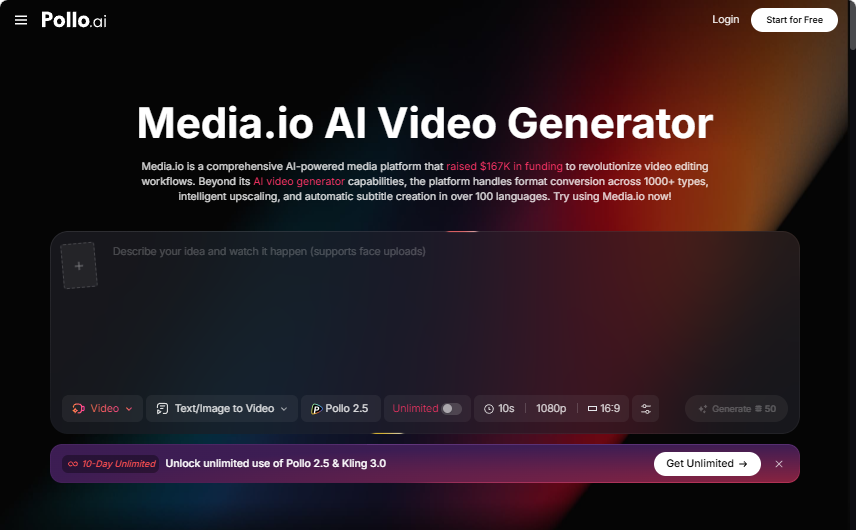
Media io addresses the full post-production layer in a single platform. It automatically upscales resolution and improves overall video quality, converts seamlessly between more than a thousand audio and video formats, removes or replaces video backgrounds with precision AI tools, generates and clones voice for narration and voiceover work, and automatically generates and translates captions across more than a hundred languages.
For travel content targeting international audiences across multiple platforms with different technical specifications, Media io handles every post-production requirement without requiring separate tools for each task.
Step 4 — Structure Your Content for Each Platform
With your optimized clips ready, structure your content specifically for each platform rather than publishing a single version everywhere. For short-form platforms — Instagram Reels, TikTok, YouTube Shorts — select your most visually striking clip as the opening two seconds, structure a narrative arc within sixty seconds, and ensure captions are present and accurate.
For longer-form YouTube content, assemble your clips into a travel narrative with a clear emotional arc — arrival, exploration, discovery, departure — and use any authentic filmed footage you have to add personal presence at key narrative moments.
For Pinterest, which consistently outperforms expectations for travel content reach, vertical format with strong opening visuals and text overlay performs particularly well. Media io’s format conversion capabilities make producing platform-specific exports from a single master file straightforward.
Step 5 — Publish, Analyze, and Refine
Publish your content according to a consistent schedule rather than in irregular bursts. Algorithmic distribution on every major platform rewards consistency of publishing cadence as much as individual content quality. Track performance metrics — reach, engagement rate, save rate, and click-through rate — for each piece of content and use that data to refine your image selection criteria, motion prompt approach, and platform-specific structuring decisions over time.
Real Results: What This Workflow Produces
Travel creators who implement this workflow consistently report meaningful improvements in content reach and engagement compared to static photography alone. The combination of AI-generated motion, professional-quality audio matching, and platform-specific optimization produces content that competes effectively with traditionally filmed travel video — at a fraction of the production time and without requiring any additional equipment or filming.
The speed advantage is particularly significant for trend-responsive content. When a destination or travel format is trending on a platform, the ability to produce and publish relevant video content within hours — rather than days — is a meaningful competitive advantage. This workflow makes that speed achievable without sacrificing quality.
How This Compares to Traditional Travel Video Production
Traditional travel video production — planning shots, filming footage, logging and organizing clips, editing a timeline, color grading, adding music, mixing audio, and exporting — requires either significant personal time investment or outsourced production cost. For a single polished three-minute travel video, the total production time using traditional methods can easily exceed fifteen to twenty hours.
The workflow described here — curating source images, generating animated clips, optimizing in post-production, and publishing with platform-specific formatting — compresses this timeline dramatically. A comparable piece of content can be produced in two to four hours, including iteration time. For creators publishing multiple pieces of content per week, this time saving is transformative.
The trade-off is that AI-generated content, however visually compelling, does not capture the authentic spontaneity of filmed footage. The strongest travel content typically combines both — AI-generated atmospheric visuals providing the visual backbone, with genuine filmed moments providing personal presence and authenticity. This hybrid approach captures the efficiency advantage of AI generation without sacrificing the authentic connection that drives audience loyalty.
Conclusion: Stop Leaving Your Travel Photos Underutilized
The travel photography you are already producing is worth significantly more than its current deployment as static social media posts suggests. The visual workflow closed loop — AI image-to-video generation through Pollo AI, post-production optimization through Media io, and platform-specific publishing — converts that existing asset value into the video content format that every major platform now rewards.
The implementation is straightforward. Curate your strongest images, generate animated clips with specific motion prompts, optimize for each platform’s technical requirements, structure your content for platform-specific audience behavior, and publish consistently. The workflow is learnable in a single session and scalable across your entire content calendar.
Your travel photo archive is not a static record of places you have been. It is a dynamic content library waiting to be activated. The tools to do it are available now — the only remaining step is to begin.