
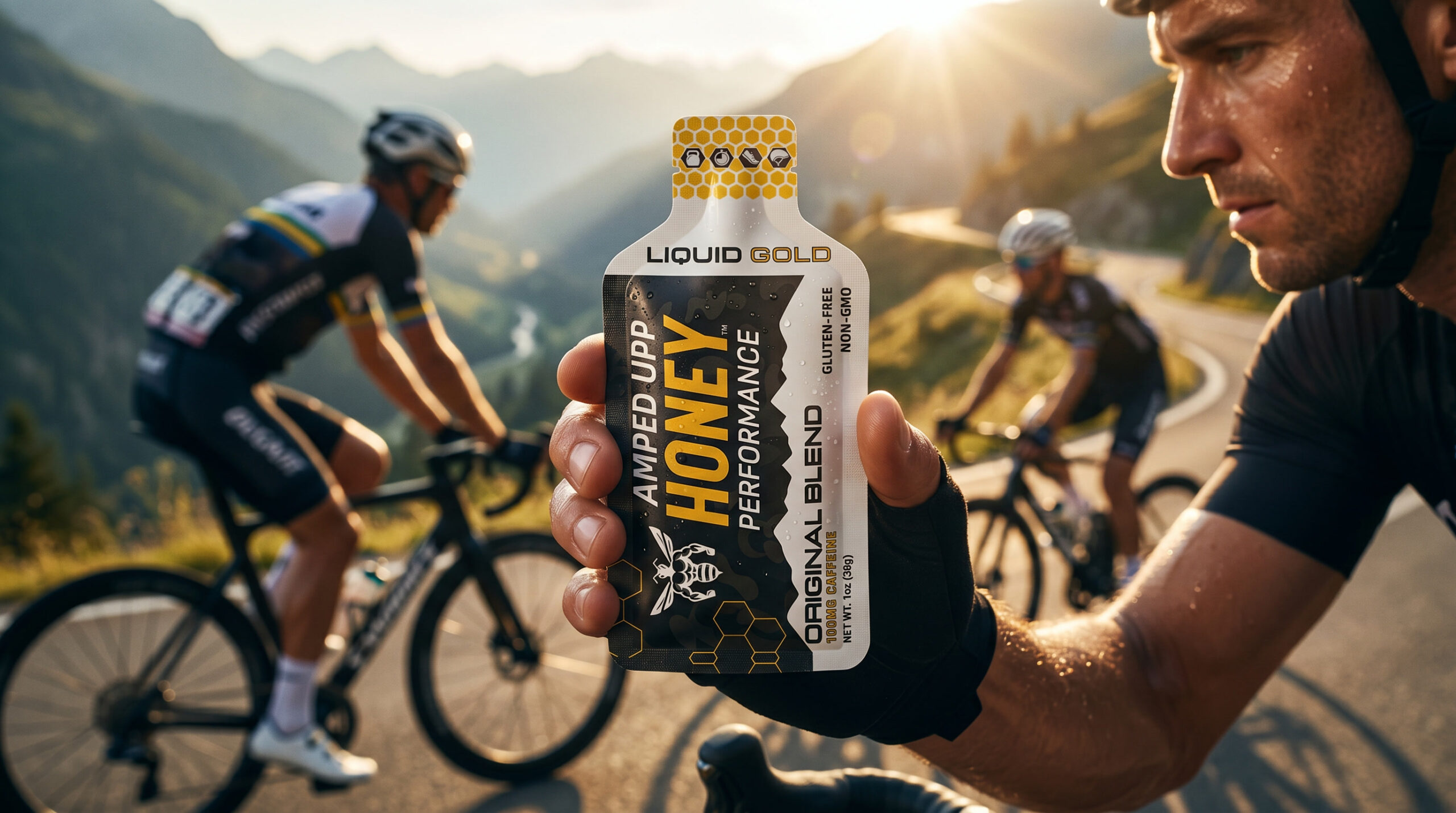
You are somewhere around mile 45. The group is still together, the road is kicking upward, and your legs are starting to ask questions your last gel answered an hour ago.
This is the part of a long ride that separates a well-planned fueling approach from one cobbled together at the last second. It is also the kind of moment where what you put in your jersey pocket before rolling out starts to matter.
Amped Upp Honey is not a gel. It is not a bar. It is an all-natural, organic honey-based pre-workout built around organic raw honey and green tea caffeine. It delivers strong energy in a single-serve packet that fits in a pocket before you clip in.
For cyclists who ride long, knowing where Amped Upp Honey belongs in a fueling plan can make a practical difference.
Why Long Rides Need a Real Fuel Plan
Short rides, such as a 45-minute spin, an hour on familiar roads, or a quick ride before work, leave little room for mid-ride nutrition to become a major factor. Riders often go out, use what they have available, and get home without drama.
Long rides are a different challenge.
A ride pushing three hours, a hilly gravel route, a long group ride with a hard final hour, or a century on the calendar all demand that cyclists think about fuel in phases: before the ride, through the middle stretch, and heading into the back half.
Miss any phase, and the ride can become harder to manage. Pedaling through a long day on nothing but instinct and willpower is a reliable way to reach the end feeling more depleted than necessary.
A smart long-ride plan typically includes starting fueled before you roll, carrying something in your pockets for mid-ride support, drinking consistently, and having real food on hand for longer efforts.
Amped Upp Honey has a specific role inside that plan. It complements, not replaces, your broader fueling strategy.
Where Amped Upp Honey Fits Before the Ride
The most natural starting point is pre-ride, right in line with how Amped Upp Honey is designed to be used.
Taken before you head out, following the brand’s general pre-workout timing guidance, many cyclists describe a strong, controlled lift in energy and alertness that carries into the early miles.
For cyclists, this matters because rolling out flat and underpowered on a long day can make the first hour feel harder than it should. A single packet before the ride can support a sharp, ready feeling before the first climb or sustained effort block arrives.
Some riders will find one packet before the ride is the entirety of what they need from Amped Upp Honey on that particular day, especially on rides up to two to three hours that are moderate in intensity and well-supported with food, water, and electrolytes.
Take it with water, time it well, and roll.
When to Carry an Extra Packet During the Ride
On longer rides, such as routes stretching four hours or more, high-intensity gravel efforts, back-to-back training days, or rides with a demanding second half, carrying an additional packet makes sense as an option, not an obligation.
A common moment to use it mid-ride is a natural pause point: a rest stop, a bottle refill, a regroup moment with the group, or the base of a long climb where the effort is about to increase.
These natural checkpoints give you a practical opportunity to take the packet with water before the next demand hits.
This is not a rigid schedule. It is a matter of reading the ride.
Some cyclists may reach for that second packet on a five-hour gravel ride with two big climbs left. Others may feel solid on food and water alone and carry it home unused. Having it available is what matters.
Most cyclists may use PRE6-WORKOUT™ Original Blend for long-ride fueling, but PRE7-WORKOUT™ CAS Boost can also be used as long as timing has been tested during training.
Cyclists who already train with PRE7 can continue using it on long rides if they know how it fits their routine. The priority is familiarity, not novelty on a key ride day.
How to Use It with Bottles, Electrolytes, and Real Food
Amped Upp Honey works alongside a fueling plan, not instead of one.
For long rides, that plan should still include water in the bottles, electrolytes to support hydration over hours of sweating, and real food, such as bananas, bars, rice cakes, chews, or whatever a given rider reliably tolerates.
Take each packet with water. It generally mixes cleanly when taken with fluid, and keeping hydration consistent around it can support comfort during the ride.
Pairing it with a salty snack at a mid-ride stop, for example, is a practical combination that covers multiple needs at once without complicating the routine.
Electrolytes remain a separate responsibility. Long rides, especially in heat or on hilly terrain, require consistent attention to what you are losing through sweat. Carry electrolyte tabs or mix them into a bottle as usual.
Think of the packets as occupying their own lane: energy support in a portable, natural format. Build the rest of the plan around that.
How to Carry Packets Without Making the Ride Messy
Single-serve packets are genuinely easy to carry on a bike.
A back jersey pocket holds several without noticeable bulk. Riders who prefer to keep jersey pockets for food and tools can tuck packets into a small saddle bag, a top tube bag, or a handlebar bag depending on what fits their setup.
The practical approach is to pre-stage packets before the ride.
If the plan calls for one before rolling out and one mid-ride, set the pre-ride packet next to your shoes, helmet, or coffee mug so it gets taken before the rush of leaving.
Put the mid-ride packet in whatever pocket or bag is easiest to reach on the bike. No fumbling required, because cycling already supplies enough tiny inconveniences to keep civilization humble.
On race day or fondo day, avoid introducing a new carrying system. Use the same setup tested during training. Simple logistics matter when the ride gets hard.
How to Test Timing Before Race Day or a Big Ride
Testing during training is one of the most practical pieces of advice for any cycling nutrition product, and it applies clearly to Amped Upp Honey.
Use training rides to learn how the product fits your timing, effort, and stomach comfort before a target race, century, or major fondo.
Pick a long training ride and use Amped Upp Honey the way you plan to use it on the bigger day. Note how pre-ride timing feels in your legs and focus.
If carrying a second packet, try it at the point you expect to use it during the event. Pay attention to how your stomach handles it, how the alertness and drive feel, and whether the timing aligns with the ride’s natural demands.
Two to three training rides with the same routine can give you enough feedback to ride race day or fondo day with more confidence.
Adjust based on what actual rides teach, not assumptions. A revolutionary idea, apparently.
How to Keep Your Long-Ride Fueling Simple
Long-ride fueling gets complicated fast when riders layer too many products together without a clear sense of what each one does.
The cleaner approach is to know what you are taking, know when you are taking it, and make sure nothing overlaps in a way that creates discomfort or confusion mid-ride.
For cyclists who want a simple framework, it might look like this: one packet of Amped Upp Honey before rolling out, consistent hydration with electrolytes in the bottles, real food at planned stops, and an additional packet available if the ride calls for it.
That is a manageable system. It does not require spreadsheets, a full nutrition protocol, or a jersey pocket packed like a panic drawer.
The goal is to reach the end of a long ride having pedaled well, eaten consistently, and stayed sharp without spending the whole ride worrying about what to take and when.
Keeping the plan lean leaves more attention for the actual riding.
Make Amped Upp Honey Part of Your Long-Ride Setup
Long rides reward preparation. The cyclists who roll out with something real in the pocket, not just a prayer and half a granola bar, tend to get more out of the hours they put in.
Amped Upp Honey fits into that preparation as a strong, portable, natural option that goes with you rather than staying back at the car.
If a long ride is coming up, whether it is a training block, a target century, a gravel event, or a big weekend ride, test Amped Upp Honey on the rides leading into it.
Find your timing. Find your carrying setup. Get comfortable with how it fits your fueling routine. Stock a few boxes before the block starts so the packets are there when the ride is.