
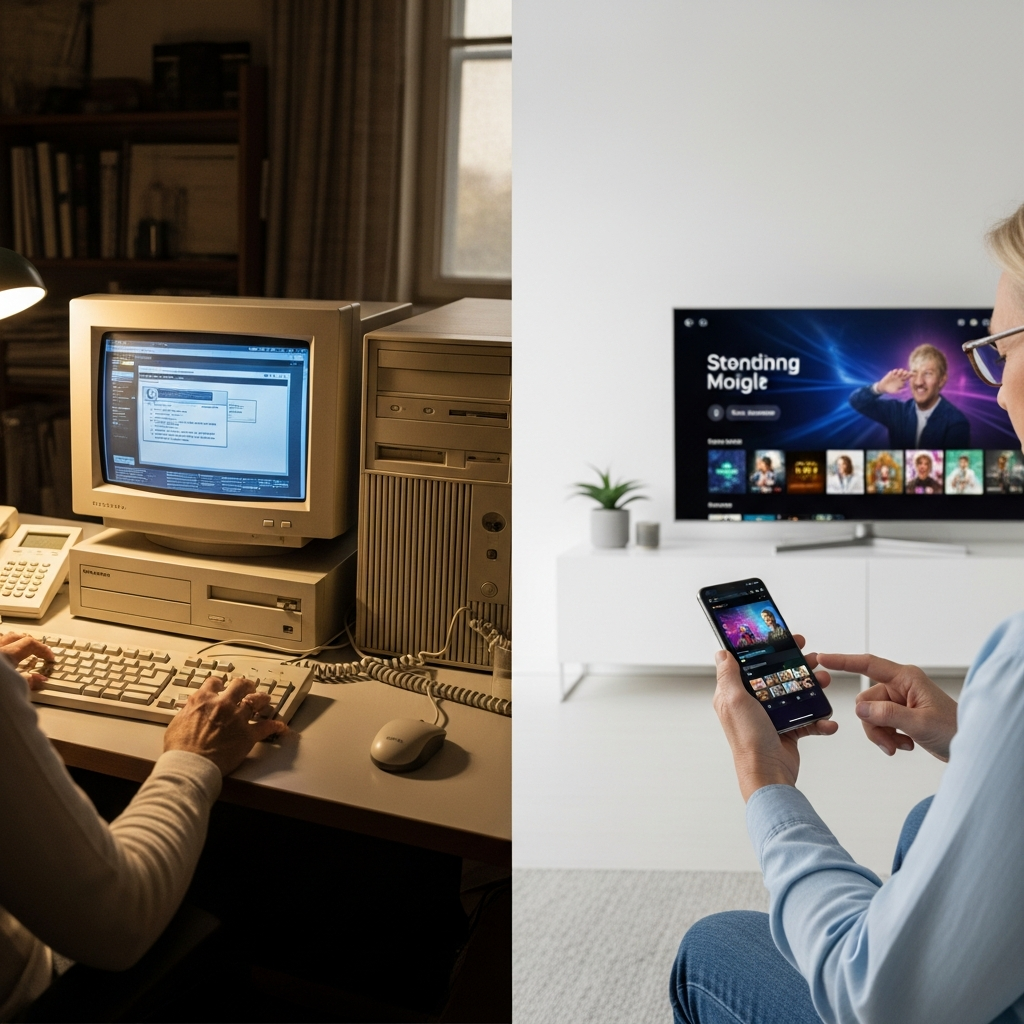
If you’re old enough to remember the distinctive, screeching symphony of a 56k dial-up modem, you’ll know just how far we’ve come. There was a time when “going online” was a planned event. You’d have to make sure nobody needed the landline, click a button, and wait several minutes for a single image of a weather map to slowly crawl down your monitor. It’s worlds away from the instantaneous, always-on world we live in now, where our phones are basically pocket-sized supercomputers.
The UK’s journey from those early, clunky portals to the sleek entertainment hubs we use today is quite a story. It isn’t just about faster cables; it’s about how our entire way of consuming information and having fun has merged into one seamless experience.
The ISP Legacy: How Supanet and Early UK Portals Shaped Information Access
Back in the late nineties and early noughties, the gateway to the internet wasn’t a search engine like it is today. Instead, we had “portals.” When you signed up with an Internet Service Provider (ISP), they usually bundled a homepage that acted as your front door to the web.
Think back to the days of Supanet or Freeserve. These companies weren’t just providing a connection; they were curate-ing our entire digital world. Based in Burnley, Supanet became a household name by offering “free” internet access, which was a revolutionary concept at the time. Their portal was a busy grid of news, sports scores, and very basic email services.
I remember the excitement of logging on to see a headline about the Premier League or a snippet of celebrity gossip. These sites were static, heavy on text, and incredibly slow by today’s standards. If you wanted to see a video, you were looking at a tiny, pixelated window that buffered every three seconds. Yet, these portals were vital because they taught us how to navigate a world that felt infinitely large and slightly overwhelming. They were the training wheels for the British public’s digital life.
Digital Convergence: The Evolution from Static News to Multi-Vertical Entertainment Hubs
As the years rolled by, the way we used these sites started to change. We moved away from having one site for news and another for entertainment. Everything began to bleed together. This is what tech folks call “digital convergence,” but for us at home, it just meant life got a lot more convenient.
Broadcasters like the BBC and commercial giants like Yahoo! UK started turning their websites into “multi-vertical” hubs. You didn’t just go to a site to read a news report; you went there to watch highlights, check your stocks, and eventually, play games. The walls between different types of media started to crumble.
This shift was driven by our own appetites. We stopped being passive consumers who just read what was on the screen. We wanted interactivity. We wanted to be able to jump from a news article about a new film directly to a trailer, and then perhaps to a forum to talk about it. The UK’s digital infrastructure had to grow up fast to keep up with these demands. According to Ofcom’s historical reports, the rapid take-up of ADSL and later fibre-optic broadband was what truly broke the ceiling for what these portals could offer.
The Tech Catalyst: How 5G and Stable Connectivity Transformed the Home Hub Experience
If broadband was the engine that got us moving, 5G and modern fibre have been the rocket fuel. It’s hard to overstate how much stable, high-speed connectivity has changed the “home hub” experience. We’ve moved from a single PC in the corner of the living room to a house full of connected devices, all pulling data simultaneously.
The real magic of 5G isn’t just the download speed, though being able to download a full HD movie in seconds is lovely. It’s the latency—or rather, the lack of it. That near-instant response time is what has allowed for truly high-fidelity entertainment. We’re no longer tethered to a desk. We can stream 4K video while sitting on the bus or join a high-stakes multiplayer game from a park bench.
This level of connectivity has turned our smartphones into the ultimate entertainment hubs. Everything is integrated. Your social media feed likely has live news updates, shopping links, and video content all interspersed. This stability has also paved the way for more complex software to run directly in our browsers or through apps without any lag or stuttering, making the “spinning wheel of death” a mercifully rare sight.
Modern Micro-Entertainment: Why Online Casino Slots and Short-Form Content Define the New Digital Scroll
This brings us to where we are now: the era of micro-entertainment. Because we’re always connected and often on the move, our entertainment has become bite-sized and incredibly polished. Whether it’s scrolling through sixty-second videos or playing a quick game during a lunch break, we’ve become experts at filling the gaps in our day with high-quality digital experiences.
The jump in graphical fidelity over the last decade is perhaps most obvious when you look at how web-based gaming has evolved. Many of us remember the early Java or Flash games that were popular on those old ISP portals. They were charming but very basic, often clunky and prone to crashing. Fast forward to today, and the software architecture has undergone a massive transformation.
Modern online casino slots are a perfect example of this technical leap. If you look at platforms like Bally Casino, the level of detail is staggering. We’ve moved from simple 2D sprites to complex, cinematic animations and immersive soundscapes that would have been impossible on a dial-up or even an early broadband connection. These games now utilise HTML5 and advanced server-side processing to deliver an experience that’s as smooth on a smartphone as it is on a high-end PC. It’s a testament to how 5G has enabled developers to push the boundaries of what’s possible in a browser window.
This trend of “the scroll” defines our modern habit. We want things that are visually engaging and instantly accessible. The sophistication of the tech behind the scenes means that whether you’re watching a high-definition stream or playing a game, the transition is seamless. We’ve reached a point where the tech is so good, we’ve almost stopped noticing it.
The Future of UK Leisure: The Rise of the Super-App
Looking ahead, the lines are only going to get blurrier. We’re seeing a significant move towards the “super-app” model, a trend that’s already massive in Asia and is rapidly taking hold here in Britain. This is the ultimate peak of digital convergence.
In the future, your favourite news app might not just tell you what’s happening in the world; it will likely be the same place you manage your bills, chat with friends, and find entertainment. The growth of verticals like online casino slots within larger entertainment platforms represents the pinnacle of this trend. It’s a world where gaming, socialising, and news consumption don’t just sit side-by-side—they overlap.
We’ve come a long way from the Burnley offices of Supanet and the wait for a webpage to load. The UK has embraced a digital lifestyle that is fast, integrated, and incredibly varied. While I might occasionally miss the nostalgic “bong-clunk” of an old modem, I certainly wouldn’t trade it for the incredible, high-speed entertainment world we have at our fingertips today.
***
Please remember to gamble responsibly. It’s important to stay in control and only spend what you can afford. If you ever feel like you need support or just want to talk to someone about your gambling habits, there are many organisations ready to help. You can find advice and resources at BeGambleAware.org or call the National Gambling Helpline on 0808 8020 133. Most UK platforms also offer tools like deposit limits and self-exclusion to help you keep things fun and safe.