
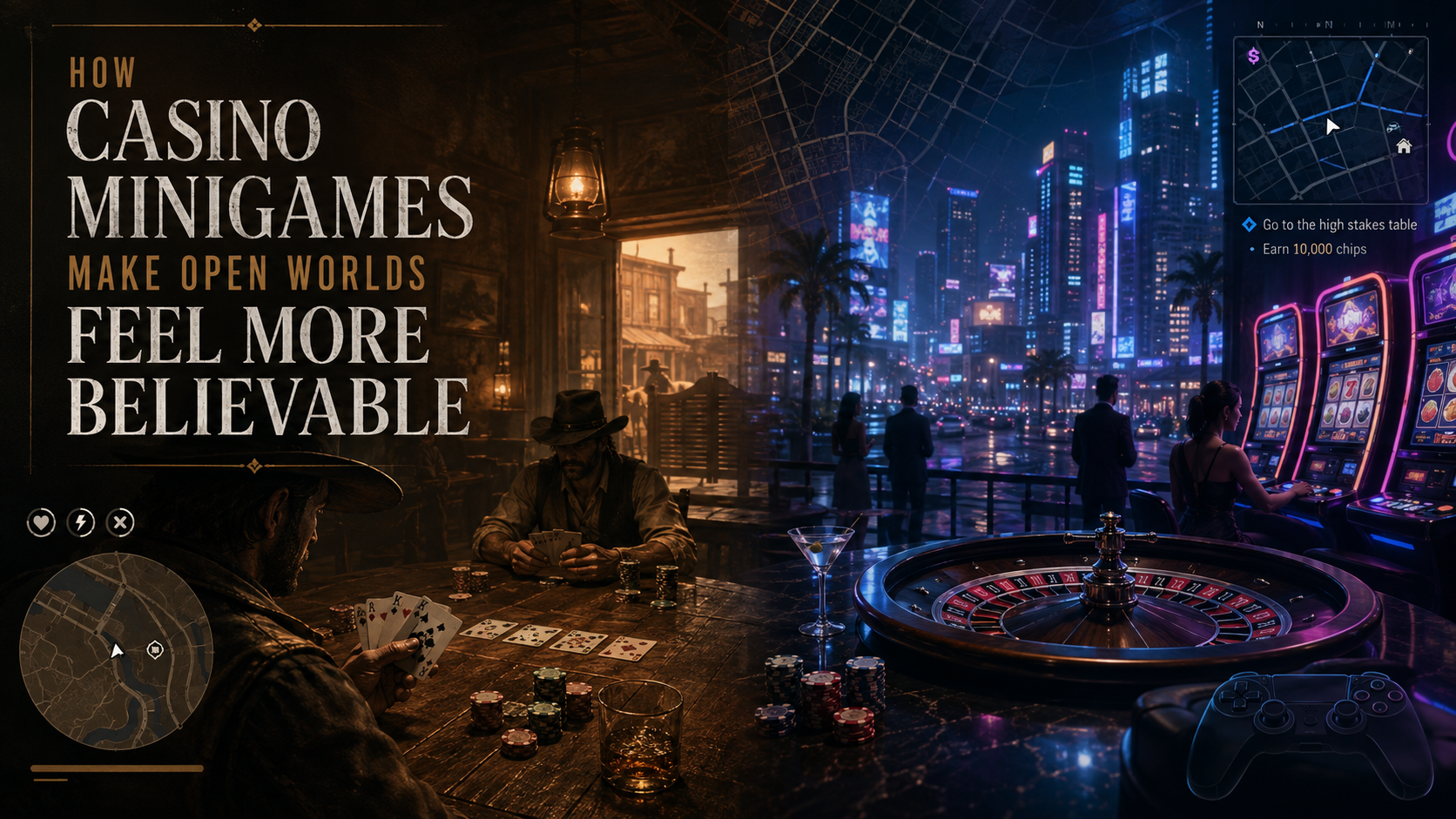
The most convincing open worlds are not always the largest. They are the ones that appear to function when the player is not looking. A saloon keeps dealing poker hands, a casino enforces its limits and a backroom gambling den follows customs that existed before the protagonist walked through the door.
That is why casino minigames in open world games can contribute more to a setting than another mission marker. Readers interested in comparing these fictional systems with the games and structures found in real online gambling environments can find further information at gamerules.com/online-casinos/. In both cases, the appeal comes from entering an institution with its own logic: the house sets the rules, the other players have money and losing carries a cost within the surrounding economy.
When those details line up, the table stops feeling like optional content. It becomes evidence that the world has a life of its own.
A good minigame makes the player follow local rules
Most open-world activities are designed around the protagonist. Enemies wait at their posts, quests remain available indefinitely and locked areas eventually open through progress. Gambling changes that relationship. The player must sit down, place a valid stake and accept an outcome produced by rules that do not bend to their level or equipment.
The money also matters. Losing a gunfight may simply reload a save, but losing at cards removes currency earned through missions, trading or exploration. The minigame and the surrounding adventure share the same economy, so the fiction and the mechanical consequence point in the same direction.
Familiarity helps designers get there quickly. Poker, blackjack and dice games arrive with recognizable objects and rhythms: cards are dealt, bets are placed, someone wins and the table resets. Even players who need a short rules explanation usually understand what kind of social space they have entered. Art direction, ambient dialogue and local variations can then do most of the world-building.
The activity also changes the pace. Open worlds constantly ask players to travel, collect and fight. A table asks them to stop. That pause makes a town feel like a destination rather than scenery between objectives.
Red Dead Redemption 2 uses poker to reveal a dishonest world
Ordinary poker in Red Dead Redemption 2 is deliberately modest. Arthur Morgan can join Texas Hold’em games in saloons and at camp, but the stakes are small compared with the money available later in the story. The point is not to create a fast route to wealth. It is to let Arthur inhabit the same leisure culture as ranchers, laborers and members of his own gang.
The Chapter 4 mission A Fine Night of Debauchery changes the meaning of that familiar table. Arthur boards the Grand Korrigan riverboat in Saint Denis as part of a scheme involving Trelawny and Strauss. The game is fixed, the hands are scripted and Strauss is present to signal what Arthur should do. Poker has moved from an everyday pastime to a stage for fraud.
One optional gold-medal objective asks the player to win without Strauss’s help. That creates a neat tension: the scene is crooked, but the player can still demonstrate that they understand the honest game underneath it. The rules learned in quiet saloons become useful inside a story mission without turning poker into a separate tutorial or puzzle.
The table also mirrors the gang’s wider situation. Arthur enters a wealthy room wearing borrowed respectability, wins through a setup and is accused of cheating. The minigame works because it is not merely placed inside the narrative; its structure expresses what the narrative is already about.
GTA Online shows how a fictional casino can meet real restrictions
The Diamond Casino & Resort brought a large collection of gambling activities to GTA Online in July 2019, including blackjack, roulette, three-card poker, slot machines, virtual horse racing and the Lucky Wheel. It also introduced an awkward boundary between fictional money and real regulation.
Players use GTA dollars to obtain chips. Those dollars can also be acquired through paid Shark Cards, although casino winnings cannot be converted into real-world cash. Rockstar added purchase limits and disabled casino gambling features in a number of jurisdictions. Access has continued to vary by region as local rules and platform policies have changed.
That regional split makes Los Santos more believable in an unintended way. The casino is part of a satirical virtual city, yet its services are not equally available to every visitor. A legal rule outside the game changes what a character can do inside it.
There is a broader design lesson here. A minigame can become so legible as gambling that it inherits some of the practical complications of the activity it represents. The Diamond Casino is not realistic because its roulette simulation is elaborate. It feels real because money, access and jurisdiction all shape the experience around the wheel.
Fallout: New Vegas lets the house recognize a dangerous winner
In many games, mastering a side activity creates an unlimited source of income. Fallout: New Vegas gives the casinos an answer: they stop taking your bets.
The Courier’s Luck attribute influences gambling outcomes, so a character built around high Luck can win with striking consistency. Each major casino tracks net winnings and eventually bans the player from further gambling. The thresholds differ by venue: 5,000 chips at the Atomic Wrangler, 9,000 at Gomorrah, 10,000 at the Tops and 15,000 at the Ultra-Luxe. The smaller Vikki and Vance Casino has a 2,500-chip limit once its tables become available.
These bans are permanent for gambling, but they do not erase the rest of the location. The player can still enter, exchange chips and use other services. In other words, the casino reacts specifically to the behavior that threatens its business.
That distinction is excellent world-building. High Luck is not only a number improving a probability calculation; it becomes a trait noticed by institutions in the Mojave. The house protects itself, the Strip remembers what happened and the player’s power meets a credible limit.
Yakuza makes gambling part of place, etiquette and exchange
The Yakuza series treats gambling as a social ecosystem rather than a single universal menu. Western casino games appear alongside Japanese traditions such as cho-han, cee-lo, koi-koi and oicho-kabu. The mix tells the player something about Kamurocho before any character explains it: imported nightlife and older forms of gambling occupy the same district, but not necessarily the same rooms.
In Yakuza Kiwami, traditional gambling uses wooden tags rather than ordinary cash at the table. Tags are purchased and winnings can be exchanged for prizes. The extra conversion step may look inefficient from a purely mechanical perspective, yet that friction is exactly what gives the venue its character. Entering the space, understanding its currency and learning what can be redeemed are all part of participation.
This is where many weaker minigames fall short. They reproduce the central rules but remove the surrounding ritual. Yakuza keeps the ritual: where the player goes, what is used as a stake and how value leaves the room. The result is not just a set of odds hidden behind an interface. It feels like a local practice.
Gwent and Kingdom Come turn leisure into cultural evidence
Not every world-building game needs a casino. The Witcher 3 uses Gwent to make politics portable. Its decks are tied to powers and peoples from the setting, and their mechanical identities reflect different strategic ideas.
Nilfgaard favors spies, medics and card advantage. The Northern Realms reward round wins with an extra draw and are particularly strong with siege units. Monsters are known for Muster combinations that can flood a row, while Scoia’tael emphasizes flexible Agile units and the ability to choose who takes the opening turn. Playing a faction therefore feels like handling a simplified model of its military identity rather than selecting a cosmetic theme.
Collecting cards also gives mundane buildings a purpose. An innkeeper is no longer only a shop interface; that character may be an opponent or sell a missing card. Gwent creates a reason to revisit settlements after their main quests are finished, making the social map overlap with the physical one.
Kingdom Come: Deliverance takes a different approach. Its tavern dice game is a Farkle variant played with six dice, usually to 4,000 points. A player can bank a scoring roll or continue and risk losing the unbanked points from that turn. Special dice can alter the odds, connecting a simple push-your-luck game to exploration and inventory choices.
Farkle is not securely documented as a game from the period depicted, so it should not be treated as a museum reconstruction. Its success comes from coherence rather than proof of origin. Dice, wooden tables, small wagers and the temptation to press one’s luck fit the tavern setting so naturally that the minigame supports the period atmosphere without demanding a history lesson.
Pokémon shows what disappears when a minigame no longer fits
The Game Corner once gave Pokémon’s cities a slightly disreputable adult space. Players could use slot machines, collect coins and exchange them for prizes. It was a small system, but it implied that these bright cities contained businesses and habits not designed exclusively for young trainers.
Its removal happened gradually. In the European release of Pokémon Platinum, the Game Corner building remained, but the slot machines could not be played. In HeartGold and SoulSilver, versions released outside Japan replaced the slots with Voltorb Flip, a puzzle that retained risk and reward without simulating a casino machine in the same way. Later mainline games moved away from the Game Corner model altogether.
Ratings standards and regional concerns about simulated gambling formed part of that shift. The important design consequence is easy to overlook: removing a minigame also removes a type of place. A prize counter can survive, and a puzzle can reuse some of the economy, but the city loses the social meaning created by a room full of machines and gamblers.
That makes Pokémon a useful counterexample. Minigames do not simply fill spare minutes. They establish what adults do for entertainment, how businesses earn money and which behaviors a society tolerates. When the activity disappears, part of the setting goes with it.
Five tests for a believable casino minigame
| Design question | Strong world-building | Weak implementation |
| Do the stakes matter? | A loss is noticeable in the local economy | The wager is trivial or disconnected from normal currency |
| Can the house respond? | The venue sets limits, controls access or refuses play | The player can extract infinite value without consequence |
| Does the activity belong somewhere? | The table is tied to a saloon, casino, tavern or hidden room | The game opens from any menu with no sense of place |
| Are there social rules? | Currency, opponents and etiquette reflect the setting | Only the probability model changes |
| Does it reveal the culture? | The game explains status, law, leisure or local history | It exists solely to add playtime or rewards |
The common thread is resistance. New Vegas stops a winning streak. GTA Online changes access by jurisdiction. Yakuza asks players to use a venue’s own system of value. Red Dead Redemption 2 makes poker honest in one setting and crooked in another.
These restrictions may be inconvenient, but convenience is not the same as credibility. A world starts to feel independent when it can tell the protagonist how things work—and occasionally tell them no.
Which open-world minigame made its setting feel most alive to you: the rules themselves, or everything happening around the table?