
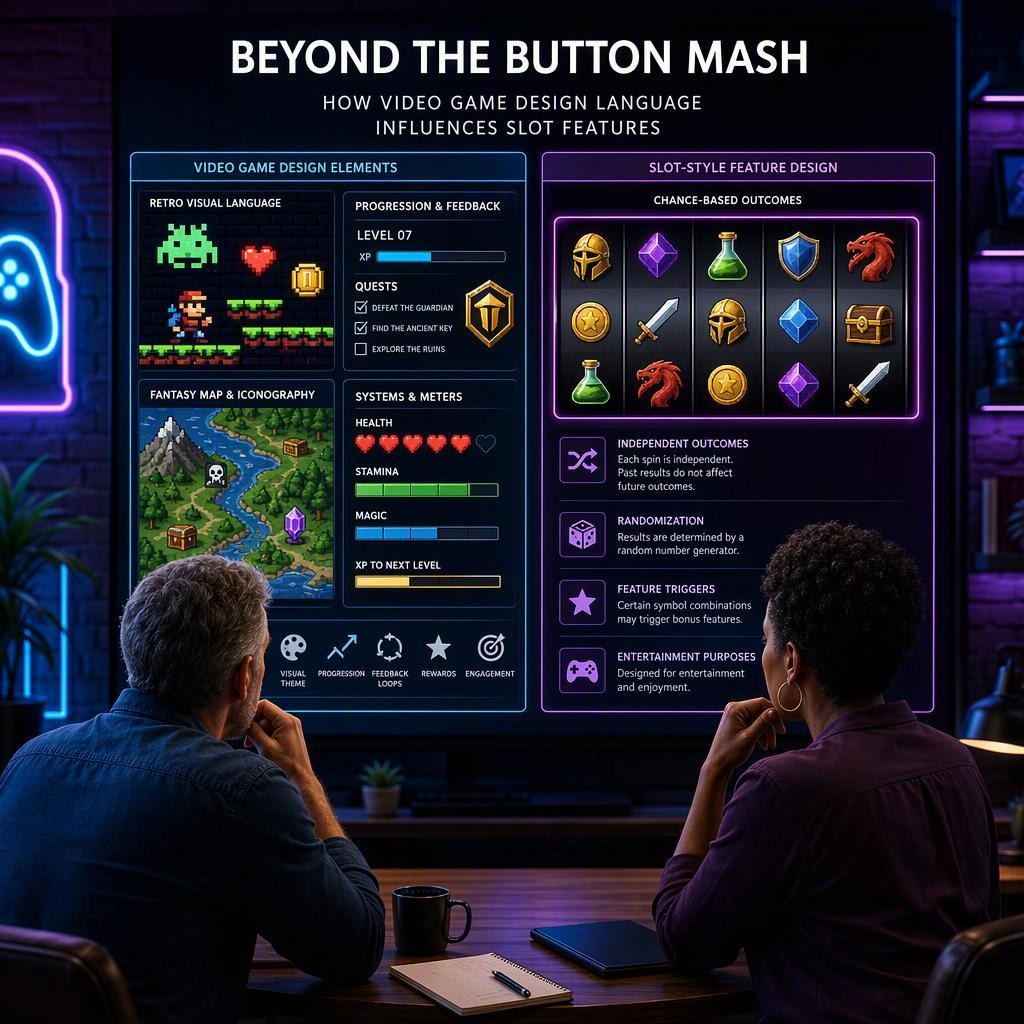
Digital entertainment has a habit of borrowing familiar ideas. A glowing progress bar, a dramatic reveal, a themed world, a clear reward for completing a task, these design choices appear across all sorts of screens and formats.
That doesn’t mean every form of entertainment works in the same way, of course. A console adventure, a mobile puzzle game and a slot game can all use colourful visual cues or themed artwork, while relying on very different rules and player experiences.
Still, it’s easy to see why familiar mechanics catch our eye. If you’ve spent years noticing level indicators, collectible icons and menu systems, you’ll recognise some of that visual language elsewhere. The interesting bit is understanding what has travelled across formats, and where the similarities stop.
Why familiar mechanics move between digital formats
Good interface design makes things easier to read. It tells you what’s happening, what has changed, and what you can look at next. That’s true whether you’re navigating an RPG inventory, browsing a retro collection or opening a mobile app during a quiet break.
The shared ingredients are often straightforward:
- Clear icons and labels
- Colour changes that signal an event
- Theme-led menus and sound design
- On-screen information that explains a feature
- A sense of sequence, from one screen or stage to another
These are not exclusive to video games. They’re general design tools, shaped around the way people absorb information quickly.
Retro influences are especially enduring. Pixel-style lettering, neon grids, synth-inspired sound effects and arcade cabinet visuals have become a visual shorthand for a particular era of digital culture. The appeal isn’t just nostalgia. Strong retro design is usually legible at a glance, with bold shapes and high-contrast cues that work well on a small screen.
For readers who enjoy looking back at older formats, retro gaming remains a useful umbrella term for playing and collecting earlier computer and console games. Its influence now reaches far beyond original hardware.
Progression and player feedback: why a small signal can feel meaningful
Video games are brilliant at giving you feedback. You land a difficult jump, complete an objective or find a hidden item, and the game responds with a sound, animation, badge or updated counter.
That response matters. It confirms that something happened.
In many games, progression is structured around familiar markers:
- Levels or chapters, which divide a larger experience into manageable parts
- Unlocks, which open access to new areas, characters, equipment or modes
- Collections, which let players track what they’ve discovered
- Visual indicators, such as maps, meters, stars and achievement panels
- Momentum, created by moving from one clearly defined task to the next
Not every game needs all of these. A short arcade-style title might use a score and a high-score table, while a sprawling adventure could have maps, skill trees and dozens of side objectives. Either way, the player is being given a readable sense of place.
This is partly why interface details are so memorable. Think of the satisfying click of a menu selection, the glow around a newly available option, or the small animation that confirms a choice. Even when the action itself is simple, presentation gives it character.
It’s worth separating this from the idea of skill, though. In video games, progression often reflects learning, timing, planning or persistence. In other digital entertainment formats, similar-looking cues may simply explain a feature or mark an on-screen event. The visual language can overlap without the underlying system being alike.
Finding a theme that suits your taste
For plenty of people, theme comes before mechanics. You might not know exactly what you want to play, but you know you fancy something with a certain look, setting or mood.
That’s why genre labels remain so useful. They give us a quick route through an enormous amount of digital entertainment.
Retro and arcade style
Retro themes often borrow from coin-operated machines, early home computers and 8-bit or 16-bit art. Expect chunky fonts, bright blocks of colour, electronic sound effects and score-inspired displays.
The attraction is immediate. You don’t need a long explanation to understand the visual reference. A neon spaceship, a pixelated cityscape or a cabinet-like frame does much of the work.
Fantasy and mythology
Fantasy settings make room for castles, magical artefacts, distant kingdoms and legendary creatures. Mythology takes a similar route, drawing on stories from ancient Greece, Egypt, Norse tradition and beyond.
These themes are popular because they give designers plenty to play with visually. Symbols, background scenes and feature names can all contribute to a coherent setting. You’re not simply looking at a menu or a set of icons, you’re being invited into a small, stylised world.
Adventure and exploration
Adventure themes tend to lean on maps, temples, lost relics, deep-sea expeditions or far-flung travel. The tone can be light-hearted or more cinematic, but the core idea is recognisable: there’s somewhere to go and something to uncover.
In video games, exploration may involve navigation and player choice. In other formats, it may be more about presentation, with themed symbols and animations establishing a sense of place. It’s a subtle but important distinction.
Classic arcade aesthetics
Arcade-inspired design is often direct and energetic. It favours readable graphics, short visual loops and strong signals. That suits modern mobile screens surprisingly well, particularly when you’ve only got a few minutes to spare.
Whatever your preference, theme-first browsing can be a pleasant way to narrow the field. Start with the style you already enjoy, then read the description rather than relying on the artwork alone.
Bonus rounds and interaction, similar language but different formats
The word “bonus” appears in lots of interactive entertainment, but its meaning changes with context.
In a video game, a bonus round might be a timed stage, a hidden challenge, a different camera mode or a chance to collect extra items. It can test the same skills as the main game, or introduce a fresh twist for variety.
Slot games may also use feature rounds, pick-style screens, free-spin modes or other visual events. These can resemble familiar interactive design patterns because they use buttons, animations, symbols and clear instructions. But they are not skill challenges in the video-game sense.
That distinction is worth keeping front and centre:
- Video-game outcomes can be shaped by player input, practice and decision-making.
- Slot outcomes are chance-based, with results determined by the game’s random number generation and rules.
- A themed feature does not turn a slot into a skill-based video game.
- Reading the game information before playing is more useful than making assumptions from its artwork or interface.
A well-designed screen can make any feature easy to follow, and that’s a good thing. Clarity helps players understand what they’re seeing. It shouldn’t be mistaken for a promise about outcomes.
Mobile-first discovery and shorter sessions
Mobile devices have changed how many of us browse entertainment. Rather than setting aside an entire evening, we might scroll through options while waiting for the kettle, on a train journey or during a short bit of downtime.
That has encouraged a few design trends:
- Larger buttons and less clutter
- Portrait-friendly layouts
- Fast loading and clear menus
- Clear menus and readable game information
- Short, readable descriptions before you begin
It also means discovery matters more. With so much choice on one small screen, you need quick ways to decide whether something is for you. Categories such as retro, mythology, adventure and arcade do much of that sorting work.
For video-game fans, this can feel familiar. Mobile stores, digital libraries and streaming services all use tiles, screenshots, tags and recommendation rows. The smartest approach is to treat these as browsing aids, not as a substitute for checking the details.
A separate option for eligible adult players
This section is for adults aged 18 and over only.
Slots are a distinct, chance-based form of entertainment, not an extension of skill-based video games. They can share surface-level elements such as fantasy themes, retro visuals, animated features and touch-friendly controls, but video-game knowledge or ability does not affect slot results.
If you are an eligible adult who chooses to browse themed slot games, it makes sense to take your time with the rules, game information and available settings. Virgin Games is one example of a UK destination where adults can browse slot themes and feature descriptions.
Disclosure: This article includes a commercial/affiliate link to Virgin Games. DailyGame may receive compensation if a reader uses that link, at no extra cost to the reader.
Keep it entertainment-only, set clear personal limits before you start, and step away if it stops feeling enjoyable. It’s also sensible to use the safer-gambling tools offered by licensed operators and consult the Gambling Commission’s consumer guidance if you want to understand UK protections and support options.
The shared design language between games and slots can be interesting to explore, particularly if you enjoy a strong theme or polished interface. Just remember the boundary: familiar visuals may make something feel recognisable, but the format, rules and role of player skill can be entirely different.