
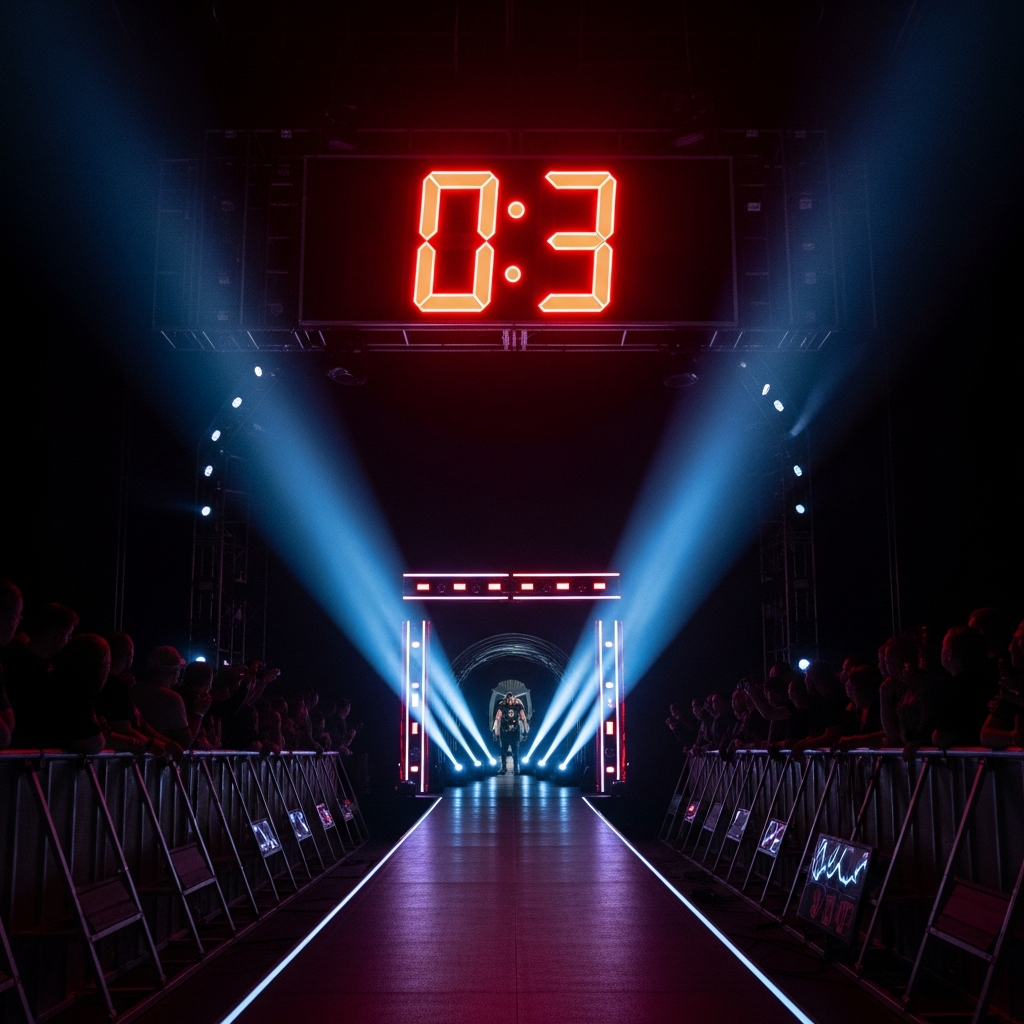
There is a specific sound that every wrestling fan knows by heart. It is the buzzing, digital countdown that echoes through a packed arena every January. For those few seconds, thirty thousand people hold their breath, eyes glued to the entrance ramp, waiting to see which theme music is about to blast through the speakers. It is arguably the most exciting moment in sports entertainment; a three second window where anything feels possible. Whether it is a returning legend, a fresh face from the developmental ranks, or a total shocker from a rival promotion, the Royal Rumble is built entirely on the foundation of the unknown.
But have you ever stopped to think about how much “luck” is actually involved? While we all know that professional wrestling is a choreographed performance, the internal logic of the match is presented as a high-stakes lottery. This “gamified” structure is exactly why the Rumble remains the most anticipated event on the calendar for many of us. It is not just a match; it is a giant, human sized game of chance that plays out over the course of an hour.
The Mystery of the Buzzer: Wrestling’s Ultimate Gamified Match
The Royal Rumble is essentially a battle royal with a twist. Instead of everyone starting in the ring at once, two people kick things off and new participants enter at regular intervals. It is a brilliant bit of pacing that keeps the energy high and prevents the ring from becoming too cluttered too quickly. From a storytelling perspective, the “luck of the draw” is the primary engine that drives the drama.
I have always thought that the Rumble feels more like a survival game than a traditional wrestling match. You could be the strongest person in the building, but if you draw number one, your odds of winning are statistically tiny. Conversely, if you draw number thirty, you are entering the fray fresh while everyone else is exhausted. It is this perceived unfairness that makes the match so compelling. We love to see a “workhorse” try to run the gauntlet from the early numbers, just as much as we love to see a villainous character gloat when they pull a high number out of the tumbler.
The match is designed to keep you guessing. Every time the clock hits zero, the “RNG” (Random Number Generation) of the booking comes into play. Even though the wrestlers themselves are following a script, the audience is engaged in a constant mental exercise of probability. Who is left? Who hasn’t come out yet? Is there a surprise slot left? This level of engagement is something very few other stipulations can achieve.
Smark Analytics: Entry Number Statistics and Historical Win-Rates
For the “smarks” (smart fans) who love to look at the data, the Royal Rumble is a goldmine of statistics. If you look at the history of the event, which started back in 1988, you can actually see patterns emerge in how winners are chosen. For a long time, there was a running joke that number 27 was the “luckiest” number in the match because it produced more winners than any other.
According to historical records, wrestlers who enter at number 27 have won the match four times (Big John Studd, Bret Hart, Stone Cold Steve Austin, and Yokozuna). However, as the event has aged, the number 30 spot has started to catch up, proving that entering last really does have its perks. Here is a quick look at some of the most successful entry positions over the years:
- Number 27: Traditionally the most successful, though it hasn’t seen a winner in quite a while.
- Number 30: The ultimate “lucky” draw, with winners like The Undertaker, John Cena, and Triple H making the most of their late entry.
- Number 1: Despite the odds, being the first person in the ring has resulted in several legendary wins, most notably Shawn Michaels in 1995 and Edge in 2021.
- Number 2: Often overlooked, but it is technically the same as being number one. Rey Mysterio famously won from this spot in 2006, setting a record for the longest time spent in a single Rumble match.
It is interesting to see how the “luck” shifted over the decades. In the early years, the winners were often the giants who could simply stand in the middle and toss people out. As the “science” of the match evolved, we started seeing more tactical wins from people who spent an hour hiding in the corners or slipping under the bottom rope. This statistical depth gives fans something to chew on in the weeks leading up to the event. We aren’t just predicting who will win; we are predicting which entry number will carry them to victory.
The Psychology of the Reveal: Surprise Entrants and High-Stakes Logic
The real magic of the Rumble, however, isn’t in the stats; it is in the surprises. The “Science of the Surprise” is a delicate thing to balance. If you have too many “legend” appearances, the current roster looks weak. If you have too few, the match can feel a bit stagnant. The best Rumbles are those that use the surprise slots to tell a story or settle a score.
Take the 2008 Royal Rumble at Madison Square Garden as an example. John Cena had been out with what was supposed to be a season-ending injury. Nobody expected him to be there. When the buzzer hit for number 30 and his music played, the reaction was deafening. That is the psychology of the reveal at its peak. It is a moment of pure, unadulterated shock that bypasses the logical brain.
Surprises work because they play on our expectations. We think we know the “pool” of available wrestlers, but the Rumble reminds us that the pool is much larger than we realise. Sometimes the surprise is a nostalgia hit, like seeing Diamond Dallas Page or Booker T return for a one-off appearance. Other times, it is a “forbidden door” moment where a star from another company shows up. This unpredictability is what keeps the “luck of the draw” feeling authentic, even when we know there is a creative team behind the curtain.
The RNG Factor: Comparing Booking Mechanics to Real-Money Gaming Logic
When we talk about the “luck” of who comes out next, we are essentially talking about a human-managed version of a Random Number Generator. In the world of professional wrestling, the “RNG” is the whim of the writers and the needs of the storyline. However, the feeling it evokes in the viewer is remarkably similar to the logic used in digital gaming platforms.
Think about how a modern gaming system works. When you are playing something that involves chance, there is a complex algorithm working behind the scenes to ensure that every outcome is genuinely random and not influenced by previous results. This is a vital part of maintaining fairness and excitement. Fans who find themselves captivated by the high-stakes unpredictability of the Royal Rumble entry order often find a similar sort of enjoyment in online slots real money on platforms like Rainbow Riches Casino.
In both scenarios, you are waiting for a specific set of variables to align. In the Rumble, you want your favourite wrestler to draw a late number and for their rivals to be eliminated early. In a gaming context, the Random Number Generator determines where the symbols land on the reels. The mechanics are different (one is a scripted television show and the other is a mathematical certainty), but the psychological engagement is nearly identical. It is all about the anticipation of the next “reveal” and the hope that the “draw” goes in your favour.
The technical parallel is quite fascinating when you break it down. Both systems rely on a “pool” of possible outcomes. In a Rumble, that pool is thirty wrestlers. In a digital game, it might be thousands of possible combinations. The goal in both is to provide an experience where the participant (or viewer) feels that anything can happen at any moment. That sense of “managed chaos” is what makes the Royal Rumble a timeless piece of entertainment.
Smack Talk: Community Predictions and the ‘Luck of the Draw’ Sentiment
As we get closer to Rumble season every year, the wrestling community goes into overdrive. Forums and social media are flooded with “mock drafts” and spreadsheets trying to figure out who is going to be the “Iron Man” of the match or who will pull off the most eliminations. There is a real sense of community in these predictions. We all have our hunches, and there is nothing quite like the feeling of being right about a long-shot winner.
I remember one year where a friend of mine was convinced that a certain mid-carder was going to go all the way. We all laughed at him, but as the match progressed and that wrestler stayed in the ring, the tension in the room became palpable. He didn’t end up winning, but for forty-five minutes, my friend felt like a genius. That is the “Luck of the Draw” sentiment in a nutshell. It allows every fan to feel like they have a stake in the outcome.
Discussion often turns to “winning big” on a hunch. Whether you are calling the winner of the Rumble from the number two spot or you are hoping for a lucky spin on your favourite game, that moment of validation is what we are all looking for. It is the reason we keep coming back to the buzzer year after year. We want to see if our internal logic matches up with the “randomness” of the world.
To keep things safe and enjoyable for everyone, it is important to remember that these activities should always be approached responsibly. If you are looking to engage in any form of gaming, please make sure you are over 18 and aware of the risks involved. You can find plenty of support and information at BeGambleAware.org.
In the end, the Royal Rumble is a celebration of the unpredictable. It reminds us that no matter how much we think we know about a subject; whether it is wrestling booking or mathematical probabilities; there is always room for a surprise. So, the next time you hear that countdown begin, take a second to appreciate the science behind the chaos. You never know who might be waiting behind that curtain.