
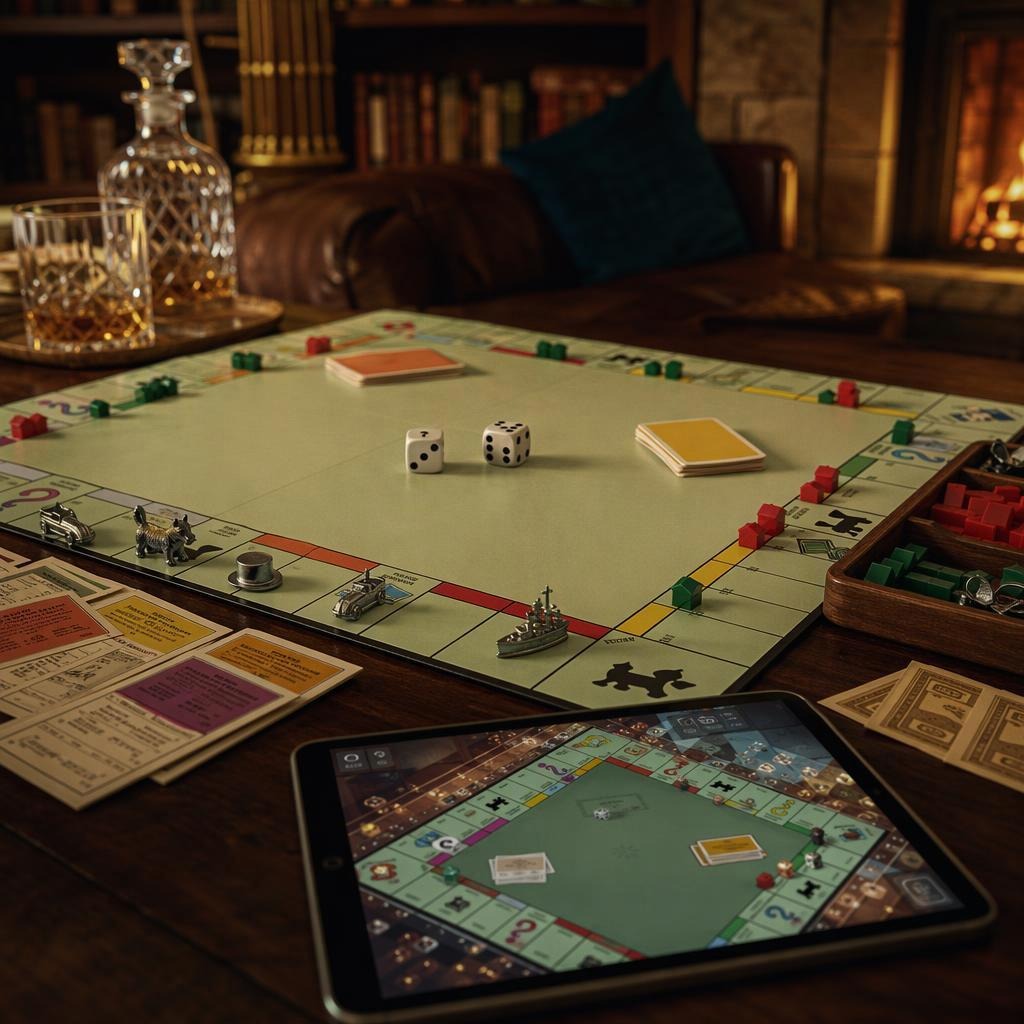
Monopoly has been around for so long that it would be easy to treat it as background noise. The board, the coloured property sets, the little metal tokens and that slightly ominous trip to jail are all instantly familiar. Yet it keeps finding new audiences, new formats and new ways to fit around a table or onto a screen.
That staying power isn’t just down to nostalgia. Monopoly has a remarkably clear set of ideas at its centre: move, acquire, negotiate, take a risk, make a plan and see how your choices affect everyone else at the table. You can understand the basics in minutes, but the social side keeps changing from one game to the next.
Its history is more complicated than many people realise, too. The game has roots in Lizzie Magie’s The Landlord’s Game, designed to explore ideas around land ownership and wealth. Parker Brothers acquired Monopoly in 1935, as outlined in Hasbro’s official rulebook history. That unusual origin gives the familiar board a little extra weight, even if most of us mainly remember family disagreements over Mayfair.
A board game built around recognisable decisions
The appeal starts with the structure. Monopoly gives every player the same route around the board, but it doesn’t give them the same experience. A lucky roll might land you on an unclaimed railway. Another turn might put you on a costly developed property. Suddenly, the mood around the table changes.
The central systems are simple enough to explain without a long rulebook:
- Roll dice and move around the board
- Buy properties when you land on them
- Receive payment from other players when they land on your properties.
- Build houses and hotels when you complete a colour set
- Draw Chance and Community Chest cards
- Trade when it suits both sides
- Keep track of the game’s notes and property positions, as the situation can change quickly.
That’s a tidy framework, but it creates plenty of conversation. Should you buy a property that doesn’t fit your current plan? Is it worth swapping a useful card or location to complete a set? Do you make a fair offer, or a cheeky one?
There’s no single answer because Monopoly is as much about reading the room as it is about counting spaces. A player who wants to trade might be up against someone determined to hold everything tightly. Another person might be keen to negotiate simply because it makes the session more entertaining. That human unpredictability is difficult to reproduce with a spreadsheet, which is exactly why the game still works so well face to face.
The tension comes from property, chance and negotiation
At its heart, Monopoly creates tension by mixing decisions with chance. Dice rolls matter, but they aren’t the whole story. You still choose what to buy, when to develop, whether to trade and how much risk feels sensible.
That balance explains why people remember particular games years later. It’s rarely just, “I rolled a six.” It’s more likely, “You offered me that trade, I nearly accepted it, and then you built three houses on the orange set.”
A few features do much of the heavy lifting.
Property gives players a stake in the board
Once you own a location, the board stops being neutral. Every circuit becomes more meaningful because other players are moving through spaces that belong to someone. Even a modest collection of properties can make you feel invested in every roll.
There’s also a pleasing visual element to it. Houses and hotels turn a flat board into a changing map of competing interests. You can see who is building momentum without needing a complicated score display.
Uncertain outcomes prevent the game becoming too mechanical.
The cards, tax spaces and jail rules keep everyone alert. You might arrive at a carefully planned outcome, only for a card to alter the picture. That unpredictability can be frustrating, of course, but it also gives the game character.
Many board games ask players to calculate every move precisely. Monopoly leaves room for calculation while ensuring that no one can fully control the route ahead. For casual groups, that often makes it easier to join in. You don’t need to memorise a huge deck of special powers before you can enjoy yourself.
Negotiation makes every group different
Trading is where Monopoly really becomes a social game. A deal that looks obvious to one person may look absurd to another. You may value a complete colour set above everything else, while somebody else wants a spread of railways or simply refuses to part with a favourite property.
That makes the game feel personal. The rules are fixed, but the stories are not.
From the coffee table to the console
Monopoly’s move into digital formats makes sense because its key systems are easy to recognise. A digital adaptation can handle the bank, calculate rent, shuffle cards and guide players through each stage. That removes a bit of housekeeping while keeping the familiar choices intact.
For people who enjoy digital board-game conversions, the benefit is often practical. Friends can play remotely, matches can be saved, and the game can manage the fiddly parts that sometimes slow down a physical session. There’s still room for negotiation and rivalry, just through a headset, chat box or sofa-side controller.
The game also sits comfortably beside strategy and simulation titles. It isn’t a deep economic simulation in the modern sense, but it shares a few appealing ideas with those genres:
- Limited resources: you can’t buy everything, so priorities matter.
- Timing: a decision that seems minor early on can become significant later.
- Visible progress: development appears directly on the board.
- Competition for space: players are all operating within the same compact system.
- Adaptation: plans change when circumstances change.
That overlap helps explain why Monopoly feels at home on screens. Digital strategy games often ask you to assess a map, manage resources and respond to other players. Monopoly does a lighter, more social version of the same thing. You don’t need an evening set aside to learn it, but you still get the satisfaction of forming a plan and watching it take shape.
The social bit matters more than the rules
It’s tempting to think Monopoly survives because everyone already knows how to play. Familiarity certainly helps, but it isn’t the entire story. Plenty of well-known games fade from view. Monopoly stays present because it gives people something to react to together.
A poor roll can prompt sympathy, teasing or a new round of bargaining. A useful trade can cause a table-wide debate. The board encourages people to watch one another, not just stare at their own collection of pieces.
That translates well into modern social play. Whether players are in the same room or joining remotely, the most memorable moments tend to come from interaction rather than the mechanics alone. The rules create the stage; the people playing create the story.
This is also why different editions and themed versions can work without losing the core appeal. Change the board’s setting, adjust the tokens or add a few visual flourishes, and people still understand the language of the game almost immediately. Property sets, cards, movement and deals are a familiar shorthand.
Familiar imagery has become part of the appeal
The Monopoly board is a strong piece of visual design. Even if you haven’t played for a while, you can probably picture the corners: GO, Jail, Free Parking and Go To Jail. You may remember the colour bands more clearly than the names of the streets.
That recognition is useful across media. On a screen, a digital version can lean into the board’s geometry, the tokens and the quick visual signal of houses appearing on a property. In other entertainment formats, the same symbols can suggest Monopoly without needing a lengthy explanation.
The imagery is simple, but it carries plenty of meaning:
- Dice suggest movement and uncertainty
- Property deeds suggest ownership and choice
- Houses and hotels show development at a glance
- The top hat and other tokens add personality
- The board’s corners give the whole game a memorable rhythm
There’s a reason these elements have lasted. They’re readable, distinctive and tied directly to how the game feels to play. You don’t have to be an expert to understand that landing on a developed property might be a problem.
Context note: themed slots within the wider Monopoly franchise
Monopoly now exists across physical board games, digital adaptations and licensed entertainment formats, each using parts of the brand’s familiar visual language in different ways. Themed slots are one branch of that broader franchise ecosystem, aimed at adults where legally permitted rather than a substitute for the tabletop game.
For readers exploring the franchise’s entertainment extensions, the themed catalogue at Monopoly Casino offers a slots-focused example of how Monopoly imagery is adapted for adult digital entertainment.
Any adult gambling content should be approached responsibly. Check the legal age and rules in your location, use publisher-provided age gates where applicable, and treat participation as entertainment rather than a way to make money.
Monopoly endures because it knows what it is: a clear, lively game about movement, ownership, luck and other people getting in your way. The board may have travelled from kitchen tables to digital displays, but the reason it still lands is wonderfully straightforward. Give people a few recognisable rules, a reason to bargain and a little room for surprise, and they’ll usually have plenty to say.